Get Full Government Meeting Transcripts, Videos, & Alerts Forever!
Get email alerts on the Care Hours Rule 10 Update topic
No spam. Unsubscribe anytime.
Denver committee briefed on Rule 10 changes to bereavement, PTO and care hours eligibility
Summary
Office of Human Resources presented proposed edits to career-service Rule 10 to align leave policies with state and federal law, clarify bereavement and PTO uses, add Indigenous Peoples Day, and change care hours eligibility to after 12 months of service; councilmembers pressed OHR on language for 'significant personal bond' and requested more usage data.
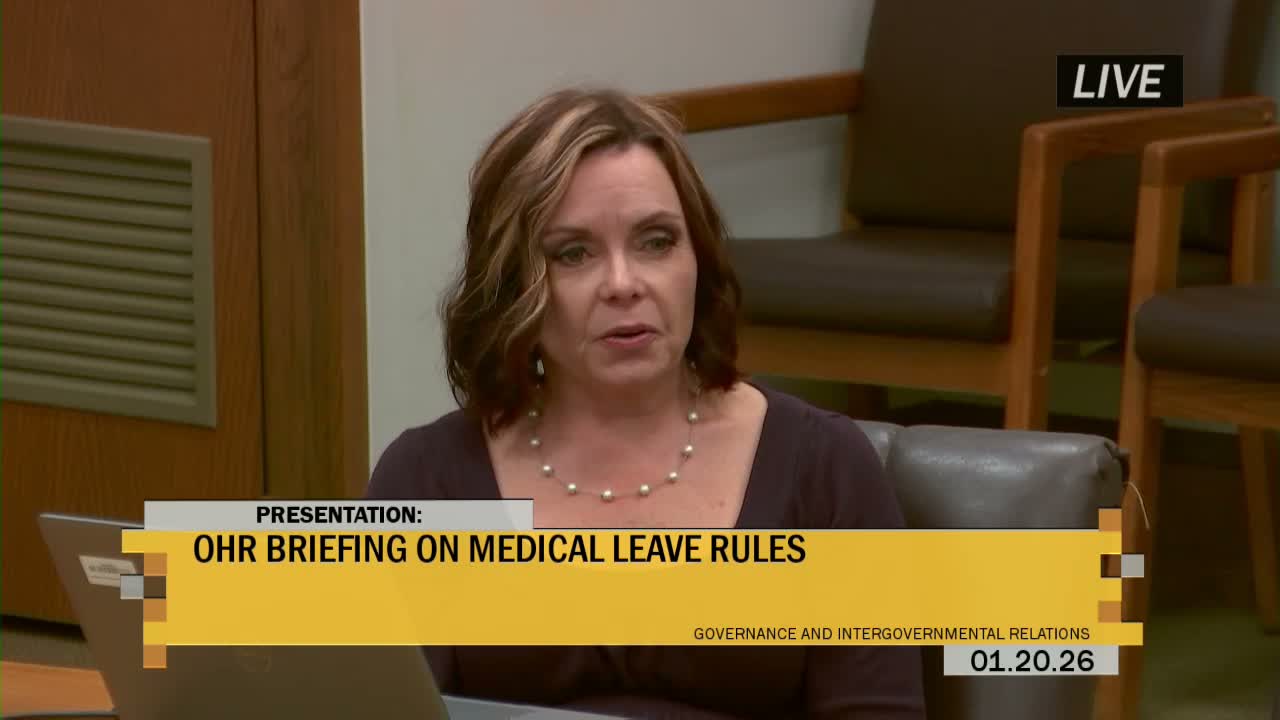
Heather Britton, director of benefits and wellness and leave for the Office of Human Resources, told the Governance and Intergovernmental Relations Committee on Jan. 20 that OHR has updated portions of career-service Rule 10 to align with state and federal law and to remove duplicative or unclear language.
The changes outlined by Britton include removing a shared-living-expense requirement for domestic partners to match the Colorado Healthy Families and Workplaces Act, expanding the immediate-family definition to explicitly include siblings' children and miscarriage for bereavement leave, clarifying PTO use when a family member's school or care site closes, and adding PTO use for evacuation of a residence due to loss of power, heating or water. "So now it's clear in our service rule if you have a miscarriage or if your sibling's child dies, you can use bereavement leave for that," Britton said.
OHR also proposed administrative adjustments: renaming "Care Bank" to "care hours," changing comp-time payout timing, aligning paid military leave language with the federal Uniformed Services Employment and Reemployment Rights Act, and adding Indigenous Peoples Day as a paid day off for career-service employees to match city ordinance.
The biggest substantive eligibility change involves care hours, the city's paid-family benefit that replaced the state's paid-family program for city employees. OHR said care hours will now be available only after 12 months of service and credited on the employee's anniversary date; previous probation-based eligibility (which varied by job classification) has been removed. Britton said the department made the change because probationary periods vary across jobs and produced inconsistent access to the benefit. OHR also clarified that using care hours in a week will not prevent an employee from working additional hours that week or from being eligible for overtime.
On usage, Britton presented historical figures showing total leave cases increasing since care hours were implemented: roughly 2,800 cases in 2022 (pre-care hours), about 3,200 in 2023, and about 3,600 in 2025. OHR reported 128 employees used care hours with fewer than one year of service in 2023, 98 in 2024, and 46 in 2025. Councilmembers asked OHR to provide additional detail on those trends and to add average, minimum and maximum hours used in future reports.
Councilmember Paradis raised concerns that removing the city's prior "significant personal bond" language and instead tracking state FCA/FMLA language could unintentionally narrow eligibility depending on how the rule is interpreted. "I am worried that we may be unintentionally narrowing that a little bit," Paradis said, and asked to see the exact statutory language. OHR said it still evaluates personal-bond requests case-by-case, generally requiring supporting medical documentation, and said it has the state language available but did not include the verbatim FCA text in Rule 10.
Another councilmember questioned whether shifting eligibility to a 12-month standard would leave some employees—who become full-time after six months under certain job descriptions—without paid care hours for an additional six months. OHR responded that probation lengths are set in job descriptions and vary by department, and that other protections (ADA job‑protected leave or donated leave) may still apply for qualifying employees.
Members asked for clarified and supplemental data; Councilmember Flynn requested that OHR add average hours per case and the range (shortest/longest) to the charts provided. OHR agreed to supply that information in follow-up documentation.
The meeting was a briefing and Q&A; the committee did not vote on or formally adopt the Rule 10 changes at this session. Chair Amanda Sawyer closed the Q&A, noted consent items (none were pulled), and adjourned the meeting.