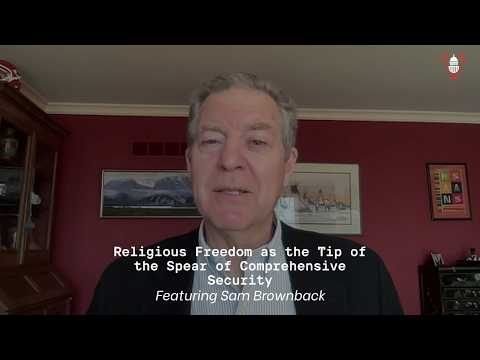
Brownback: Treat religious freedom as a global security issue
Loading...
Summary
On the Transatlantic podcast, Ambassador Sam Brownback said religious freedom should be elevated from a human-rights framing into a global security strategy, warning that authoritarian surveillance and allied regimes are targeting faith communities worldwide.
Ambassador Sam Brownback said religious freedom should be treated as a central security concern, not only a human-rights issue, in an interview on the Transatlantic podcast hosted by Bakhtanyishana. Brownback said the approach matters for confronting authoritarian states that target faith communities.
"We should use religious freedom as the tip of the spear," Brownback said, arguing that freedom of religion is deeply tied to other civil liberties such as speech and assembly and that protecting religious freedom can mobilize broad social support.
Brownback pointed to new tools and partnerships among authoritarian states as an intensifying problem. He said China, Russia, Iran and North Korea have strengthened each other and exported surveillance systems that enable governments to identify and punish religious activists: "China ships out their surveillance equipment to dozens of different countries to be able to surveil, particularly people of faith," he said.
He described patterns of repression that often favor a majority or state-aligned faith while excluding minority groups such as Jehovah's Witnesses and some evangelical communities. "If you're a Russian Orthodox church member, you've got excellent religious freedom. In any other category, you got some real questions and possible problems," Brownback said.
Brownback urged moving the International Religious Freedom Act into broader security planning and said democracy organizations and national-security practitioners are beginning to engage the issue. He told the host the International Religious Freedom Summit is expanding (with recent events in Nairobi and an upcoming meeting in Morocco) to build that wider coalition.
The podcast episode did not supply a date for the recording. Brownback made several quantitative remarks on the program (for example, saying roughly "80% of the world's population has a faith"), which the article reports as his claim and which have not been independently verified here.
Looking ahead, Brownback said the urgency is rising as surveillance technologies and allied authoritarian practices spread, and he urged policymakers to "capture this moment" before the tools become harder to confront.