Get Full Government Meeting Transcripts, Videos, & Alerts Forever!
Get email alerts on the Municipal Sentencing topic
No spam. Unsubscribe anytime.
After Supreme Court ruling, Denver officials move to align municipal sentences with state law
Summary
Following a Colorado Supreme Court ruling that municipal sentences exceeding state equivalents are preempted, Denver’s Budget & Policy Committee heard municipal public defenders outline urgent code changes to align Denver’s municipal penalties with state caps and avoid plea and due-process problems.
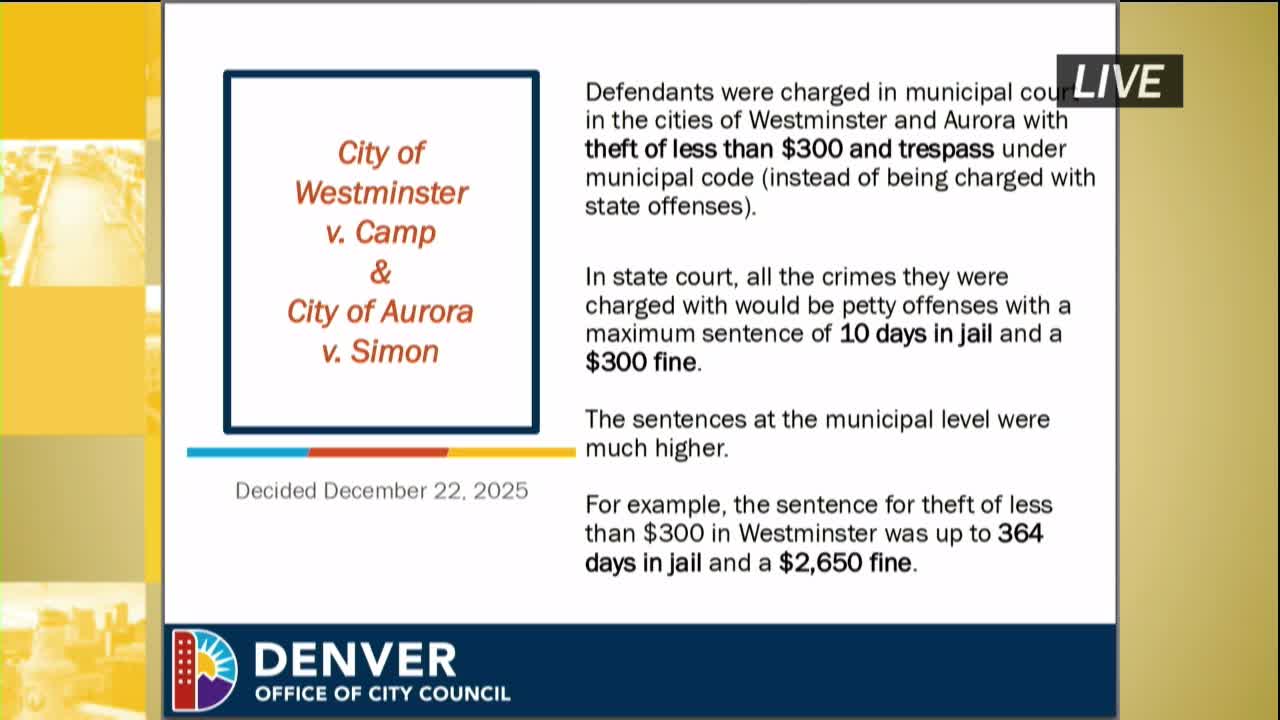
The Denver City Council Budget & Policy Committee heard detailed testimony about immediate legal and courtroom impacts after the Colorado Supreme Court held that municipal sentences that exceed equivalent state penalties are preempted.
Colette Tevet, chief municipal public defender, told the committee the decision in City of Westminster v. Camp and City of Aurora v. Simon requires that municipal sentencing caps match state law where the offenses prohibit the same conduct. She cited examples where Denver’s municipal code currently lists much higher maximum penalties—trespass in Denver remains written with a maximum of 300 days and a $999 fine while the comparable state petty-offense penalty is a maximum of 10 days and a $300 fine.
Public defenders and municipal-court practitioners described operational confusion in courts and a real risk that defendants could receive invalid pleas or incorrect advisements because plea paperwork and judge advisements still list obsolete municipal maxima. Counsel warned that defendants who were not accurately advised about the true maximum penalty could later move to withdraw pleas, creating years of case-by-case litigation.
Speakers walked committee members through common offenses affected by the ruling: trespass, petty theft and shoplifting (where state law applies tiered penalties by property value), and numerous municipal-only violations (for example, certain park curfew provisions) that may not have state analogues. The presenters urged the council to identify which municipal offenses are identical or comparable to state statutes and to revise the Denver Municipal Code (DRMC) accordingly so sentencing is clear and uniform.
Staff proposed an "implementation" ordinance to revise the DRMC so that penalties for offenses identical to state offenses match the state maximums; they recommended circulating a chart of comparable offenses, scheduling one-on-one briefings with council offices, and producing draft language quickly. City attorney staff noted Boulder had adopted a short ordinance as an interim measure that states the state maximum controls where offenses align, and counsel offered to circulate sample language as staff work through the larger drafting task.
Committee members raised practical questions about charging authority (whether DPD could cite state statutes directly), revenue impacts, and public messaging about reducing maximum penalties. Staff said municipal charges may continue but that sentencing must comply with state caps; the city attorney and OMPD promised coordinated, rapid follow-up (including a drafted chart of offenses and targeted briefings) to reduce courtroom uncertainty.
No ordinance vote took place at the meeting; staff committed to circulate a draft and convene additional briefings with council offices before returning to committee.