Get Full Government Meeting Transcripts, Videos, & Alerts Forever!
Get email alerts on the Board Governance topic
No spam. Unsubscribe anytime.
Shipman & Goodman counsel trains Bridgeport Board on FOIA, policy limits and committee rules
Summary
At a March 16 special meeting, counsel Kristin Smith of Shipman & Goodman told the Bridgeport Board of Education that Connecticut boards are agents of the state, reviewed Freedom of Information Act limits on off‑agenda discussion and email, and advised options to reduce FOIA risk around committee meetings and board communications.
Kristin Smith, an attorney with Shipman & Goodman, told the Bridgeport Board of Education on Monday evening that Connecticut boards are agents of the state and reviewed practical steps for complying with the Freedom of Information Act, policy adoption rules and committee procedures.
The training, delivered in person at City Hall, Room 305, covered three core topics: the distinct roles of the board and the superintendent; how statutory requirements and state model policies constrain local board action; and FOIA risks tied to off‑agenda conversations, email chains and committee forums. Smith repeatedly cautioned that board members risk legal exposure and improper influence if they discuss personnel or operational matters outside properly noticed public proceedings.
"If you start to engage in a dialogue off the agenda, you violated FOIA," Smith said, summarizing why board members should avoid back‑and‑forth email threads or unscheduled promises about personnel. She emphasized that the board's primary obligation is to "implement the educational interest of the state," and that many required policies come from statute and must be adopted, not invented.
Board members pressed Smith on several recurring issues. On student discipline and personnel, Smith explained that boards may delegate expulsion and residency hearings to impartial hearing officers but cannot pre‑decide termination actions that trigger a teacher's or administrator's constitutional due‑process rights. She recommended that members direct parents and complainants to the chain of command (teacher → principal → superintendent) and quietly alert the superintendent rather than promise board action.
Members also raised questions about social media and post‑vote commentary. Smith said individual members may express personal views but must not present themselves "as a member of the Bridgeport Board of Education" unless the board has voted to delegate authority for a public statement (typically to the chair) or adopted a resolution authorizing specific testimony.
Committee structure and FOIA risks dominated much of the meeting. Several members described efficiency gains from having many board members participate in policy‑committee work; Smith warned that when a forum of the full board attends a committee meeting and engages in deliberation, the public may not have been properly notified, creating a FOIA risk. She offered remedies including enlarging the committee, having non‑committee members sit in the gallery and speak only during public comment, or making a committee a committee of the whole with properly noticed meetings.
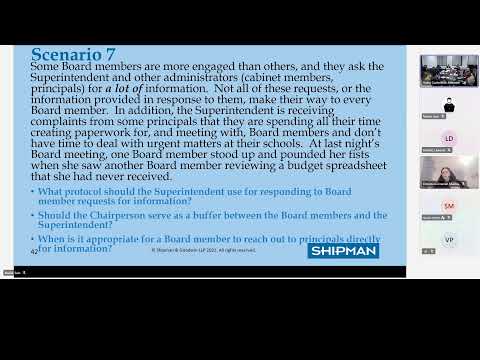
Other practical guidance included avoiding substantive discussion by text (text messages can be FOIAed), using district email addresses for board business to simplify legal holds, and routing requests for voluminous information through the chair so counsel and staff can manage cost and workload.
The meeting closed after members discussed next steps for revising bylaws and committee practices; a motion to adjourn passed by voice vote and the meeting ended at 8:41 p.m.
The training session focused on reducing procedural and legal risk and on clarifying how the Bridgeport Board should receive and forward constituent concerns to district staff for operational response.