
Minneapolis assessor reports modest rise in citywide value, steep downtown commercial declines and nearly $13 billion tied up in appeals
Get AI-powered insights, summaries, and transcripts
Sign Up Free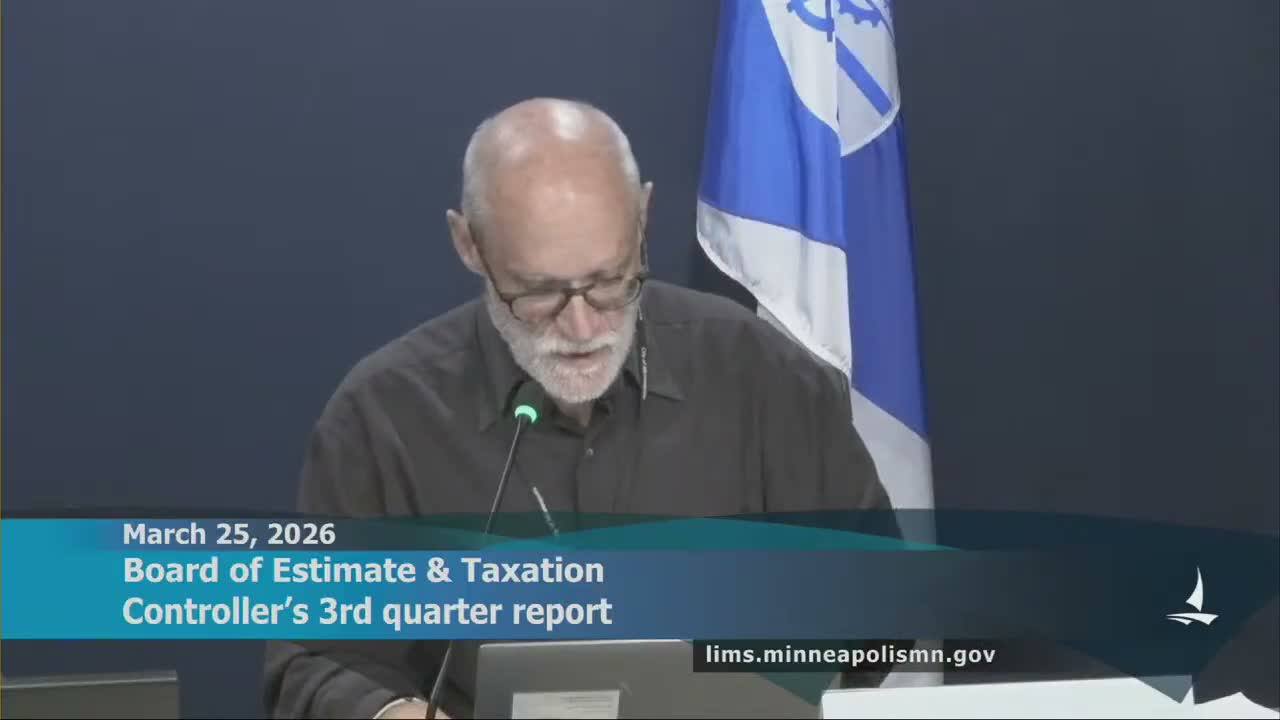
Summary
City Assessor Rebecca Malmquist told the Board of Estimate and Taxation that the city—stimated market value rose by just under 0.5% to $65.2 billion for 2026, new construction added roughly $480 million, downtown commercial values fell sharply and the office has nearly $13 billion in value under appeal.
Rebecca Malmquist, Minneapolis city assessor, told the Board of Estimate and Taxation on March 25 that the city—s overall estimated market value (EMV) increased by "just under one half of a percent" for 2026, bringing the roll to about $65.2 billion.
Malmquist said the office completed the 01/02/2026 assessment of roughly 131,000 properties and mailed value notices March 13. She emphasized the assessment uses sales from Oct. 2024 through Sept. 2025 and that those 2026 values will be the basis for property taxes payable in 2027.
"This is an annual process and is dictated in state statute," Malmquist said, and she reviewed the mechanics of converting market value to tax capacity, noting that residential properties account for more than 64% of market value but just over 55% of tax capacity after class rates are applied.
Among the numbers Malmquist presented: about $480 million in new construction was added to the roll, and the median estimated market value rose 4.6% from $333,400 to $348,900. She said the apartment market saw a net increase just under 1% and that $271 million of new construction was in apartments this year.
At the same time, Malmquist said commercial and industrial values fell: commercial values declined about 9.8% and industrial values about 1%, a combination she said contributed to an overall roughly 8% decrease across those sectors citywide. "We've seen some substantial decreases across our office buildings in the downtown," she said.
Malmquist reviewed statistical measures the state uses to judge assessment quality. Based on 3,952 sales, the office—s median sales ratio was just over 95% (the accepted range is 90% to 105%), the coefficient of dispersion for residential properties was 8.9 (within acceptable bounds), and the office continues to watch price-related differential (PRD) metrics for condominiums.
She also warned that transaction volume has fallen since 2022
"The 3,952 sales represent a 41% decrease," Malmquist said, adding that fewer sales make it harder to set and validate assessments.
On litigation, Malmquist told the board that tax-court work has increased and that for assessment year 2025 her office has "nearly, I believe, ... $13,000,000,000 under appeal in the tax court." She said rising appeals strain staff capacity and require coordination with the Hennepin County Attorney's Office.
Commissioners asked technical questions about methodology and timing. Commissioner Bernstein confirmed the sales-data window (Oct. 2024
through Sept. 2025) and Malmquist confirmed that taxes based on the 2026 assessment will be payable beginning in May 2027. When asked to explain PRD, Malmquist said the office uses every sale as a data point and takes special care reviewing high-end sales where data are sparse.
Malmquist provided procedural dates for property owners: the local Board of Appeal and Equalization convenes April 14 and the Hennepin County board convenes June 15. She said owners who question values should contact the appraiser listed on the back of their notice and that the assessor—s office maintains public tools including a property-info lookup, a sales finder and a levy-impact estimator.
The board voted to receive and file the assessor—s report.
Next steps: Malmquist said she would supply a historical tax-capacity dollar total to the board after the meeting and staff will follow up with additional transaction-level details commissioners requested.