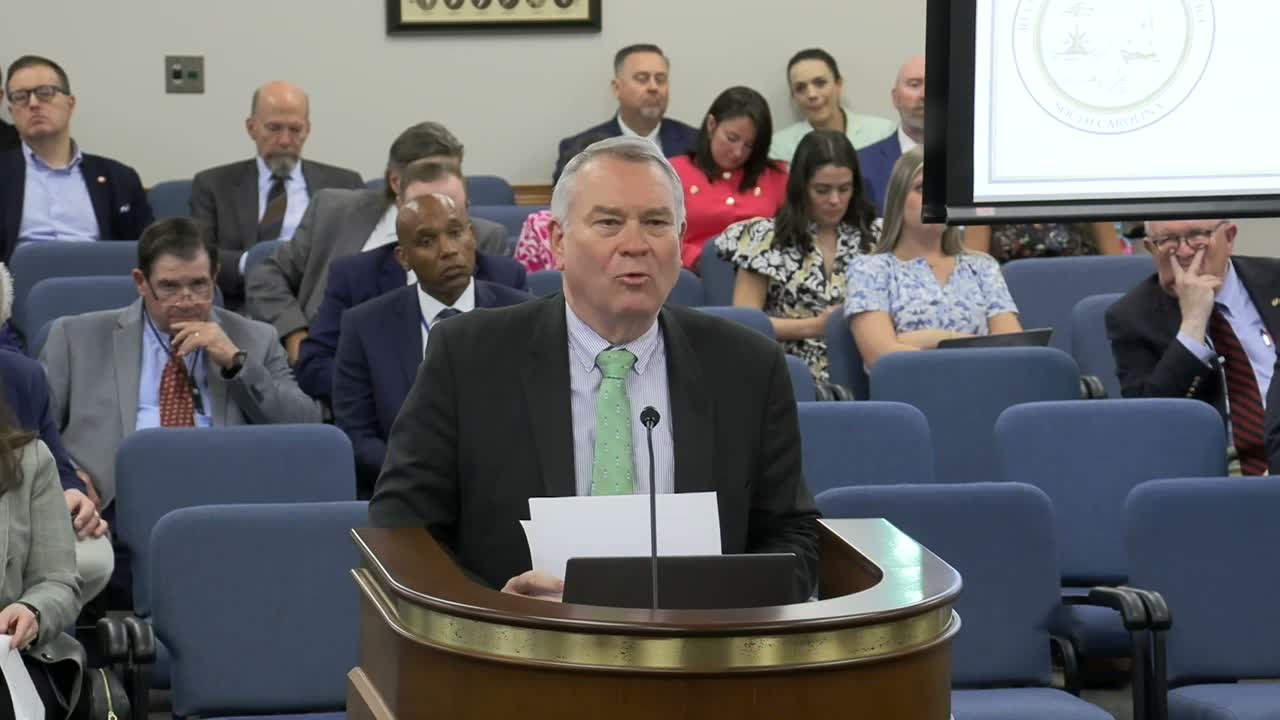
Department of Revenue official: South Carolina growth slowing from pandemic peak; $1.28 billion in tax cuts reduced recurring revenue
Loading...
Summary
A Department of Revenue official briefed legislators that South Carolina's population and income grew strongly during the pandemic but now face a return to more normal, slower growth; the official said enacted tax cuts have removed about $1.28 billion from the income-tax stream and that one-time surpluses, not recurring revenue, will drive near-term budget flexibility.
A Department of Revenue official told legislators that South Carolina's economy and population have grown rapidly but are entering a period of slower, more "normal" growth, and that recent tax cuts have substantially reduced recurring revenue available for new programs.
The presenter said South Carolina led U.S. states in percentage population growth over the past year and ranked fifth in absolute population growth, and cited a projection that the state could exceed 6 million residents by 2040. He warned that growth is uneven across counties: coastal areas such as Jasper County are expanding rapidly while some inland counties, including Fairfield County, are losing residents.
Why it matters: the presenter said pandemic-era stimulus and strong tax collections produced unusually large surpluses that enabled tax cuts and new spending, but those structural tax changes have lowered the base of recurring revenue. "As of fiscal '26, our estimate, $1,280,000,000 out of the income tax stream" was removed because of tax-cut packages, the official said.
The briefing laid out how recent revenue increases have been allocated. The presenter said roughly 65% of recurring revenue growth since the pandemic has gone to eight priorities, including aid to classrooms (19% of new recurring money), Medicaid (13%), the state health plan (10%), employee pay (8%), tuition mitigation (cited as $321 million), and transfers to the Department of Transportation (about $120 million). He said teacher pay has risen and now exceeds the Southeastern average by roughly $2,300 compared with earlier levels.
On the near-term outlook, the official said the state's long-term revenue forecast is flattening because of another tax cut implemented this session (an accelerated phase-down to 6% was cited), which will reduce growth for the remainder of the fiscal year before modest recovery is expected next year. He emphasized collections are tracking very close to estimates: excluding the April 15 filing effects, the state was about $42 million ahead of projections on the major tax categories, a much tighter margin than in recent years when surpluses exceeded $1 billion.
The presenter flagged corporate income tax as an uncertainty: collections have declined faster than anticipated, but he noted that more than 60% of corporate tax typically arrives in the last four months of the filing cycle and late filings or refund timing could change the picture.
Legislators pressed the presenter on several points. A committee member asked whether the Department of Revenue's allowing taxpayers to wait until Oct. 15 to file returns could shift refund timing into the next fiscal year; the presenter said officials must decide whether refunds or payments are allocated to this fiscal year or the next and that the timing could change the designated "pot" of money. President Alexander asked whether sales-tax receipts tied to Marketplace/Wayfair changes are tracked separately; the presenter confirmed DOR maintains separate monthly numbers for Marketplace collections and said that detail can be provided.
The presenter closed by noting the availability of one-time funds for the coming budget: about $725 million from last year's surplus (with more than $200 million unappropriated), roughly $600 million in projected surplus this year, and a capital reserve fund of about $387 million. By contrast, recurring new resources were estimated at about $734 million. He said the legislature will reconvene around May 19 to review tax-season data ahead of conference committee work.
No formal motions or votes were taken during the briefing. Questions focused on timing and classification of receipts and refunds, the composition of collections by source, and the implications of enacted tax cuts for the recurring budget base. The presenter repeatedly characterized the briefing as "dull news" but said the state remained in overall good fiscal shape while returning to more typical growth patterns.