Senate subcommittee advances bill raising legislative pay to $47,500, carves out per‑diem to limit pension hit
Loading...
Summary
A Senate Finance subcommittee voted to move S933 to the full committee after amending the bill so that $15,000 of the $47,500 total would count toward the statutory per‑diem used to calculate retirement benefits, a step intended to reduce a projected $108 million increase to the General Assembly Retirement System unfunded liability.
A Senate Finance subcommittee on Thursday voted to advance Senate Bill S933, which sets total legislative compensation and in‑district expense at $47,500 and creates a biennial inflation adjustment, after amending the measure to specify that $15,000 of that total would be treated as the per‑diem component used in retirement calculations.
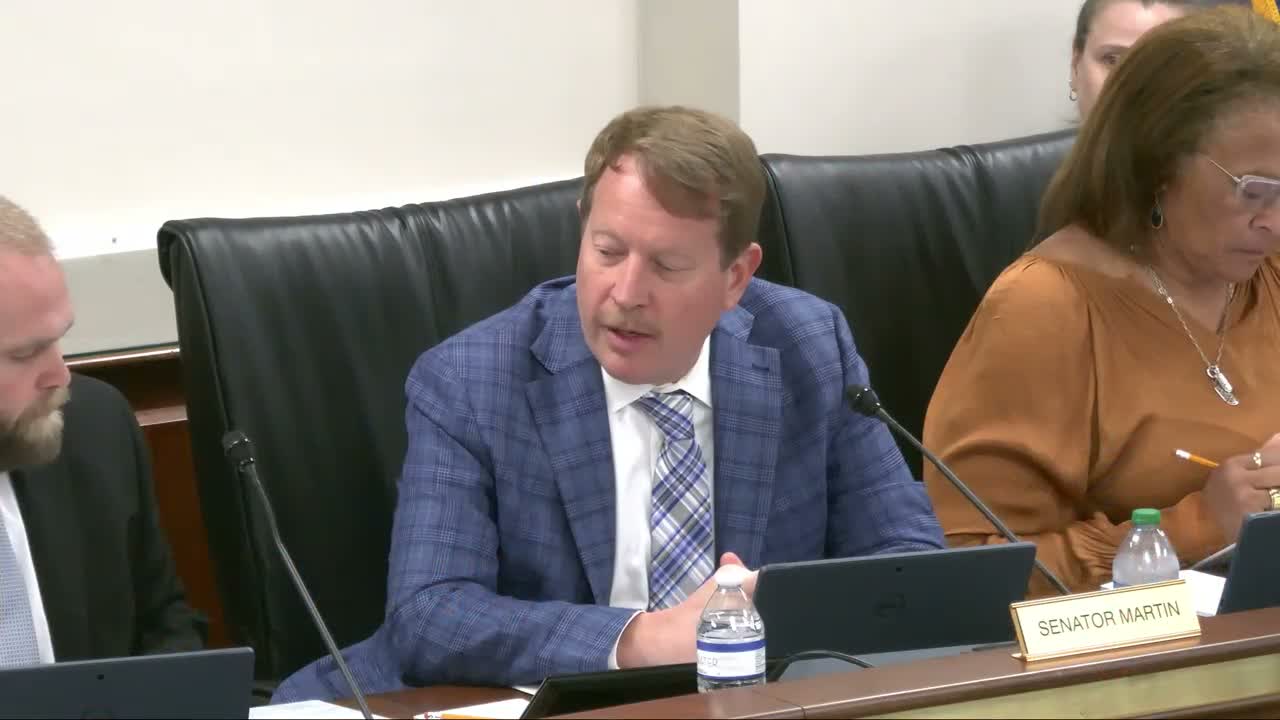
The move, made by the subcommittee chair and seconded with reservation, was framed as an attempt to preserve an inflation‑adjusted compensation structure while avoiding a large, immediate increase in the General Assembly Retirement System’s (GARS) unfunded liability. "This bill increases the legislative compensation and in district legislative expense allowance to $47,500," the bill’s presenter, Jake, told the subcommittee. "The legislative compensation and in district legislative service allowance shall be adjusted biannually... using the chain methodology" of the consumer price index, capped at 5 percent.
Why it matters: Actuarial testimony showed the way the increase is assigned to statutory compensation matters for pension costs. Miss Boykin, the committee’s actuarial/retirement staff, told senators that treating the full increase as part of the statutory compensation would raise GARS’s unfunded liability by "roughly $108,000,000," and that the system could either be funded up front or amortized over five years at about $34 million per year. "Retired members benefit is based on sitting legislators' pay," she said, explaining why the liability grows when statutory compensation is increased.
Committee debate focused on two practical options. One route — the budget proviso used last year — would implement an in‑district expense increase through the annual budget and make it effective after an intervening election to address the state Supreme Court’s timing concerns. The other would enshrine a formula in statute that automatically adjusts the compensation every two years. Legal staff said a proviso can be structured to avoid the prior Court’s timing objection, but a statutory, formulaic approach would be the straightforward path for a recurring COLA.
Opponents raised fiscal and political concerns. "I have a hard time... I oppose raising legislative compensation," the senator from York said during debate, noting discomfort with the prospect of a large pension cost. Supporters said modest, automatic adjustments help legislators avoid out‑of‑pocket costs and could broaden who can serve. The chair framed the measure as an attempt to keep members "somewhat break even in our expenses" without creating a windfall: "we're not trying to get rich down here," he said.
To reduce the actuarial cost, the subcommittee accepted the chair’s amendment to specify a smaller per‑diem base; Miss Boykin agreed the change would lower the projected GARS impact and recommended sending the chosen figure to the actuary for an updated fiscal estimate. The chair said the change would be effective starting in January 2027, consistent with the Court’s guidance.
The subcommittee voted to move S933 "favorable as amended" to the full Finance Committee. The measure will face further committee consideration and must still pass both chambers; the House may change the bill’s language or fiscal assumptions. The subcommittee did not provide a recorded roll‑call tally in the hearing transcript.
Key details extracted from the hearing: the bill sets total legislative compensation at $47,500; biennial CPI chain‑method adjustments are capped at 5 percent; Miss Boykin’s actuary estimated a roughly $108 million GARS liability if the statutory per‑diem component is increased broadly; the subcommittee amended the bill to specify $15,000 as the per‑diem component to limit that impact.
Next steps: S933, as amended, goes to the full Senate Finance Committee for more debate and a committee vote before potential floor consideration and transmission to the House.