Senate subcommittee adopts amendment on commercial aircraft tax, urges replacement funding if levy reduced
Loading...
Summary
A South Carolina Senate subcommittee adopted a strike-and-insert amendment to S.436 that changes how commercial aircraft are treated for property-tax assessment and allows fee-in-lieu agreements approved by the state coordinating council; witnesses warned that eliminating airline property tax would remove roughly $5–8 million a year from the state aviation fund unless replaced.
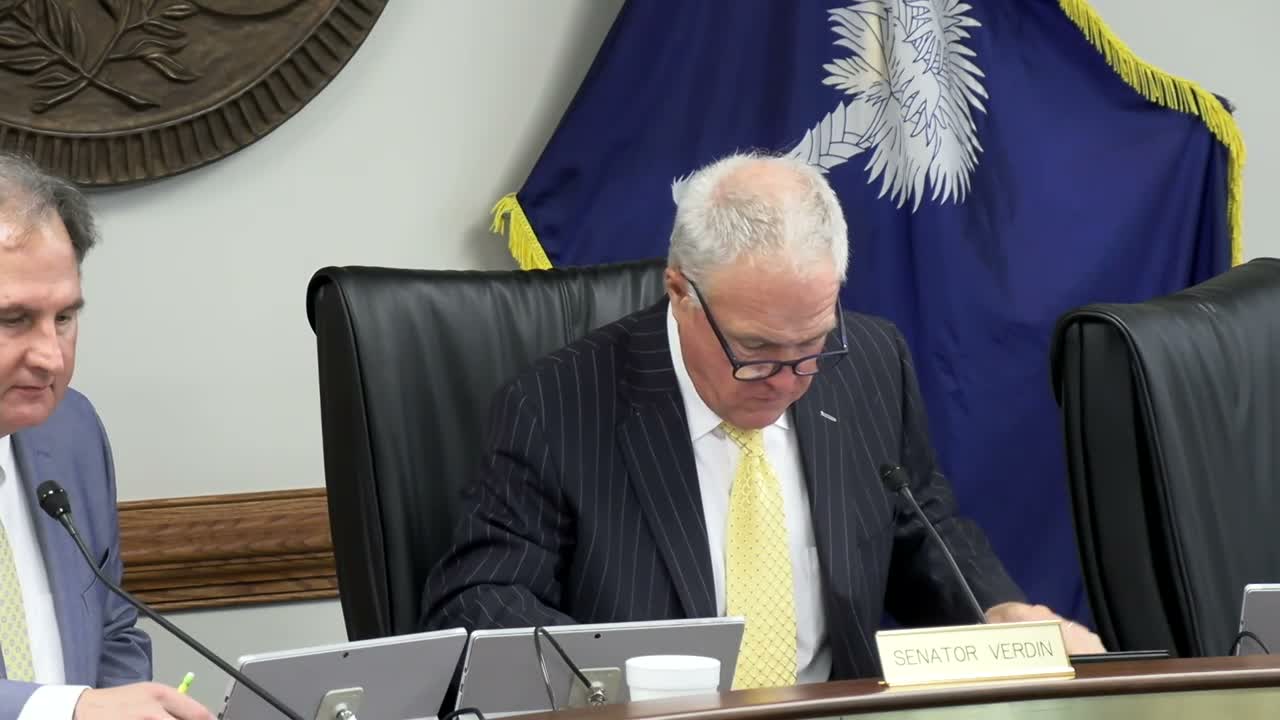
The Senate subcommittee voted to give a favorable report to an amendment to S.436 after hearing testimony that airline property tax is a crucial funding source for the state aviation system.
Gary Siegfried, executive director of the South Carolina Aeronautics Commission, told the panel the airline property tax currently provides about $8,000,000 a year — roughly 40% of the commission's recurring $20,000,000 budget — and that the state’s aviation system needs were estimated at roughly $150,000,000 annually. "Airline property tax equates to about $8,000,000...the cost to the airlines is about $1 per round trip ticket," Siegfried said, adding that the commission would support policy changes only if they were matched by "substantial, recurring, and growth-oriented" replacement funding so the state could continue leveraging federal grants and completing projects.
James Stevens, representing the South Carolina Aviation Association and speaking for the six commercial service airports, said prior fiscal work on a related bill estimated the impact at about $5,000,000 a year of the $8,000,000 the aeronautics commission currently receives. "The impact was about $5,000,000 a year out of the $8,000,000 that Gary referenced," Stevens said, and urged the committee to request a Department of Revenue fiscal-impact report and to let stakeholders review any amendment language before final action.
Staff presented a strike-and-insert amendment that replaces the original S.436 language. According to staff, the amendment moves the issue into the section of state law that sets assessment ratios (where a 9.5% ratio for transportation property currently appears), includes a temporary provision tied to that 9.5% assessment with a sunset date of June 30, 2028, and permits commercial aircraft to be included in fee-in-lieu agreements for qualifying projects if approved by the state coordinating council for economic development. Staff emphasized the coordinating council — described during the hearing as an 11-agency body — would review and approve such fee-in-lieu arrangements rather than local county councils.
Members asked who would fill any near-term funding gap if the tax were reduced. Staff estimated the gap could be "in that $5 to $6,000,000" range, depending on how fee-in-lieu arrangements are implemented and how many aircraft or projects qualify for them. Senators said the amendment provides a two-year window and mechanism to continue stakeholder conversations and recommended carrying the measure forward to the full committee for budget-level decisions.
The subcommittee then moved and voted on a favorable report to send the amended measure to the full committee; the chair called for 'ayes' and stated, 'Ayes have it.' Members reserved their rights.
The subcommittee’s action sends the amendment and underlying bill to the full committee for further consideration, including any required fiscal analyses and stakeholder review.