YWCA New Britain details community health worker training and childcare incubator to expand local care and workforce pathways
Loading...
Summary
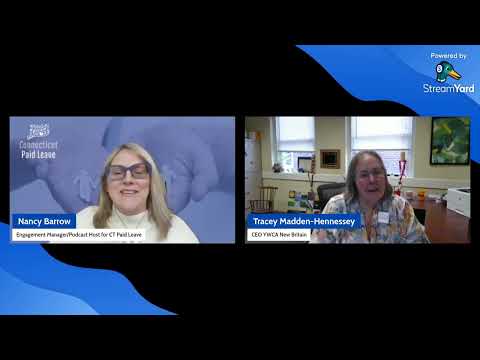
Tracy Madden Hennessy, CEO of the YWCA New Britain, told the CT Paid Leave Authority podcast that the nonprofit runs a state-aligned community health worker training for high school students and a childcare business incubator where four women operate family childcare businesses to address an infant–toddler care shortage.
Tracy Madden Hennessy, chief executive officer of the YWCA New Britain, described the nonprofit’s education and workforce programs on the CT Paid Leave Authority podcast, highlighting a community health worker pathway for high school students and a childcare business incubator intended to expand infant–toddler care in the city.
Hennessy said the YWCA New Britain, established in 1910, “serves women and girls in the greater New Britain area,” and that the organization’s mission is the empowerment of women and the elimination of racism, which it embeds in program design. She described services that include preschool through high-school educational programs, after-school programming for middle and high school students, crisis-intervention services, and job-training programs for women and girls.
One program Hennessy emphasized is a community health worker (CHW) training partnership with New Britain High School and Central Connecticut State University (CCSU), which Hennessy said has become a state-approved trainer for community health workers in the area. She said participating students take college-level coursework during the summer, complete a 90-hour practicum that uses a photo-journalism project to earn hours, and work toward roughly 1,000 community-service hours over their high-school careers so they can pursue state CHW certification.
“Community health workers are really becoming a big part of the healthcare system and they are the liaison between a lot of underserviced communities and hospitals and medical centers,” Hennessy said, describing the CHW role as a bridge between residents and health providers.
Hennessy also described the YWCA’s childcare business incubator, which she said is among the organization’s more novel initiatives. “We have an incubator site where four women are operating their own family childcare business from this shared space,” she said, noting that the site allows women who cannot operate childcare out of their homes—because of landlord restrictions, space limits or licensing obstacles—to build sustainable business models. She said participants use the site for about two to three years while developing operations and learning to meet licensing requirements.
To increase supply beyond the incubator, Hennessy said the YWCA is working with Neighborhood Housing Services in New Britain to prototype home-daycare and apartment models intended to expand infant–toddler care locally. She framed the shortage of infant–toddler slots as a barrier that prevents many women from returning to or entering the workforce.
For more information, Hennessy provided the YWCA New Britain’s main number: (860) 225-4681. The interview was part of CT Paid Leave Authority’s “5 Minutes of Impact” series; host Nancy Barrow closed the episode by directing listeners to the CT Paid Leave Authority website and podcast for additional material.
The episode focuses on program design and training pathways; it did not include new funding announcements, formal votes, or regulatory actions.