Get Full Government Meeting Transcripts, Videos, & Alerts Forever!
Get email alerts on the Transit Oriented Development topic
No spam. Unsubscribe anytime.
Committee advances bill that limits some local zoning near rail stations and prioritizes transit‑adjacent projects
Summary
The House Environment and Transportation Committee passed HB 8-94 with amendments to automatically designate some transit‑oriented developments as enterprise zones, restrict certain local land‑use limits near specified rail stations, and prioritize projects adjacent to state or WMATA rail stations for state loans; the measure drew questions about geographic scope and local control.
Chair Foley told the committee that, as amended, HB 8-94 makes several changes to state law relating to transit‑oriented development, including automatic designation of specified TODs created on or after 10/01/2026 as enterprise zones subject to a local opt‑out and similar provisions for earlier projects with local approval. The bill also establishes a scoring preference for projects that redevelop land contiguous to rail stations owned by the state or WMATA for the strategic infrastructure revolving loan program and prohibits certain local land‑use limitations near specified rail stations.
The changes would, the sponsor said, prohibit local jurisdictions from imposing parking minimums and would require multifamily residential zoning within a half mile of specified stations to allow mixed‑use development. On state‑ or WMATA‑owned land the bill exempts certain zoning controls related to land‑use classification, height and setbacks, although local authorities would retain zoning authority over environment, public health and safety and adequate public facilities.
Vice Chair Guyton asked the sponsor to reread two amendment points that had moved quickly; Chair Foley read them more slowly to clarify the local‑zoning exemptions on state and WMATA land. Delegate Naraki sought confirmation that the bill’s hourly service requirement (an example given in committee materials of 8 a.m. to 6 p.m.) remained unchanged; the sponsor confirmed the 8 a.m. to 6 p.m. weekday hourly service provision was retained.
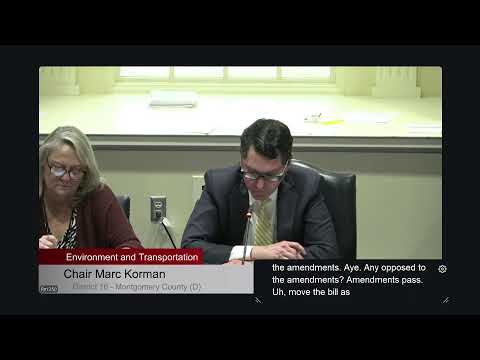
A committee member asked whether any stations meeting the bill’s high‑capacity rail definition were on the Eastern Shore; the sponsor said not yet. The chair also noted the bill had been a party‑line vote in the Economic Matters Committee. After the Q&A the committee adopted the amendments and passed HB 8-94.
The bill’s changes shift some local land‑use decision points to state criteria for developments near specified rail infrastructure and create incentives through enterprise‑zone designation and loan scoring. The committee advanced the bill to the next stage; Chair Foley said the measure’s floor consideration will reflect the committee’s amended language.