
Senate advances forensic‑facility bill with added clinical safeguards and reporting requirements
Get AI-powered insights, summaries, and transcripts
Sign Up Free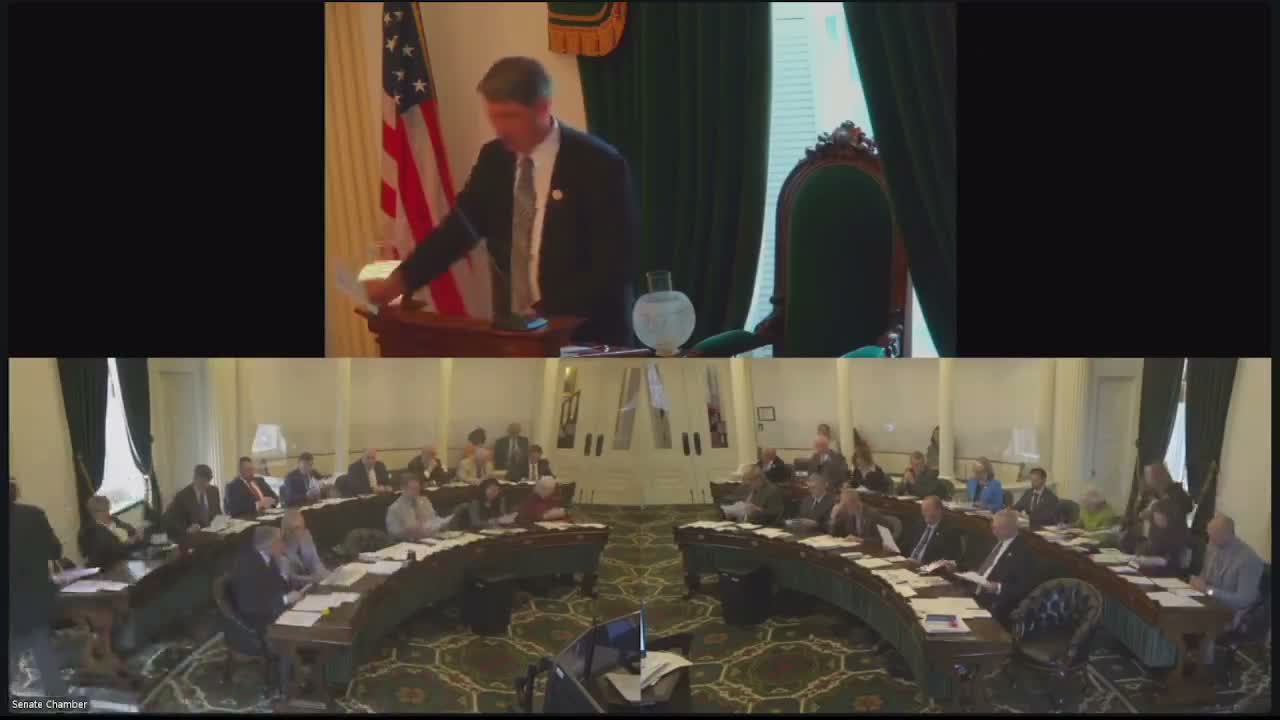
Summary
S.193 would require the Department of Corrections to establish a forensic facility for competency restoration and certain NGRI cases; floor amendments added clinical staffing, 72‑hour evaluation and interim reporting requirements and the Senate ordered third reading.
The Vermont Senate advanced S.193, a comprehensive bill to create a forensic facility model for competency restoration and care of certain criminal‑justice‑involved persons, and adopted a suite of floor amendments that add clinical standards, staffing and reporting requirements.
Senator Hashim, reporting for the Judiciary Committee, described S.193 as narrowly tailored: it would provide competency restoration services inside locked secure facilities when a court finds defendants not competent to stand trial, to persons charged with serious offenses, or to those found not guilty by reason of insanity when the court determines release would create a substantial risk of bodily injury. The reporter emphasized the bill does not require constructing new buildings; it contemplates using secured placements within existing correctional or locked settings or other locked facilities if a court finds less‑restrictive options appropriate.
The committee presentation explained procedural safeguards: defendants transferred for competency restoration would be evaluated regularly (at least every six months or sooner if clinicians certify likely competence), receive individualized treatment plans and have access to clinical staff. The report cited the high legal threshold courts must meet (clear and convincing evidence) before approving involuntary medication and noted the bill ties that standard and evidentiary requirements to existing case law (committee discussion referenced the U.S. Supreme Court precedent on involuntary medication). The reporter also said Vermont Legal Aid would continue to represent those individuals and that the Department of Corrections would consult regularly with the Department of Mental Health.
A multi‑committee floor amendment reported by the Senate Health and Welfare Committee added detailed clinical specifications: trauma‑informed treatment planning, a clinical services director, staff qualifications and 24/7 nursing or physician availability where clinically required; it also required a 72‑hour initial clinical evaluation after placement, periodic review of treatment plans, rulemaking in consultation with health agencies, an interim report on facility planning and cost estimates, and annual reporting once operations begin. Sponsors said the amendment narrows the bill’s scope and strengthens clinical oversight.
Floor debate emphasized care and legal safeguards: supporters said competency restoration is essential to ensure both defendants’ rights and the state’s ability to prosecute serious offenses; at least one senator noted the changes would apply initially to a very small number of people (committee testimony estimated roughly six individuals under current conditions). The Senate amended the committee report as offered and ordered third reading of S.193; the floor did not conclude final passage during this session.
Next steps: because the amendment requires rulemaking, interim reporting and coordination across corrections and health agencies, sponsors said implementation planning and monitoring will be central if the bill advances to final passage and enactment (the bill includes an effective date provision starting 07/01/2026 in earlier text).