Get Full Government Meeting Transcripts, Videos, & Alerts Forever!
Get email alerts on the Sewer Capacity topic
No spam. Unsubscribe anytime.
Spring Hill reviews sewer-reserve requests from local endodontist and infusion clinic; staff to return with recommendations in two weeks
Summary
The board heard presentations from Dr. Catherine McKittrick (Southern Roots Endodontics) and Cindy Nicks (12 Stone Health Partners) seeking sewer-reserve allocations during a moratorium; staff said it will work with applicants and return recommendations at the next voting meeting.
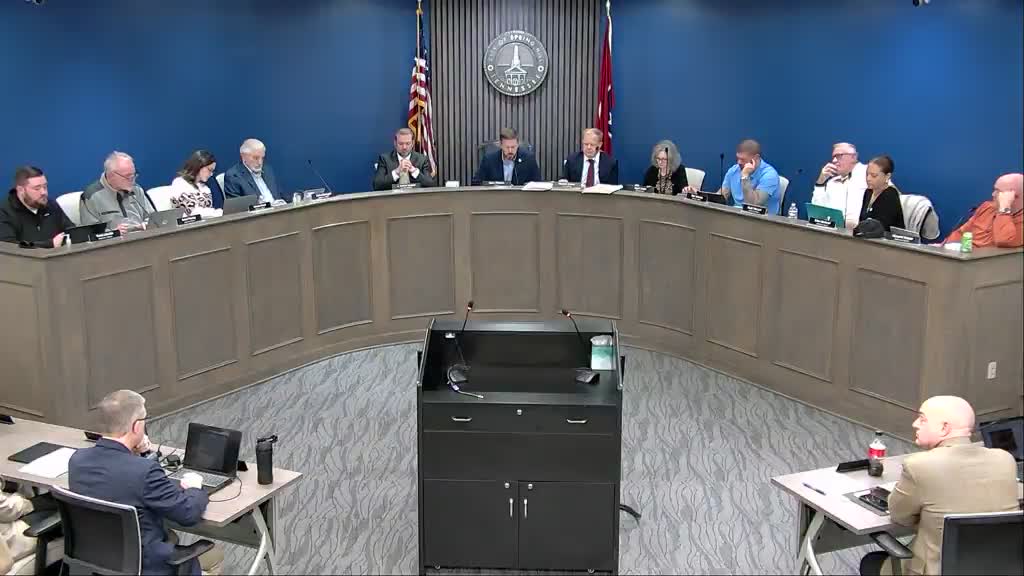
Spring Hill city staff and aldermen on [date] discussed several requests for sewer-reserve allocations while a temporary moratorium governs new connections.
Hamilton Brooks (speaker 20) introduced Dr. Catherine McKittrick (speaker 21), an endodontist who said she signed a lease in April, has invested roughly $40,000 toward opening and will move back to Spring Hill to practice. Dr. McKittrick described endodontics as a specialty with comparatively low patient volume and said she offers advanced services — including IV sedation certification — that she believes will add value to the community.
Board members questioned technical and precedent issues: how projected wastewater flow would be measured (4‑day vs. 5‑day workweek assumptions), whether the applicant’s pro forma gallons-per-day calculations were verified, how to enforce operating schedules, and whether granting an allocation would set expectations under the moratorium. Staff (Mister Allen, speaker 19) said the city would require flow monitoring and was preparing follow-up requests to the applicant’s engineer to resolve technical questions.
The board also heard from Cindy Nicks (speaker 22) of 12 Stone Health Partners, which provides infusion services and reported caring for about 3,000 unique patients in the community annually. Nicks said the relocation would not expand clinical footprint or add infusion chairs; instead the clinic would move to a similar-sized tenant space. Staff told the board it would use measured comparators (Appendix C) and expected to include comparative numbers in a forthcoming recommendation.
After extensive questioning on patient ZIP-code distribution, measured flow comparisons and legal mechanisms for monitoring, staff was directed to continue technical review and to return a recommendation for formal action at the next voting-session meeting in two weeks.
Next steps: Staff will exchange engineering and flow-monitoring data with applicants (including potential submeters or meters) and present a resolution and supporting documentation at the next scheduled voting session.