
House advances H.938 to create statewide homelessness response continuum with $82.6 million initial funding
Get AI-powered insights, summaries, and transcripts
Sign Up Free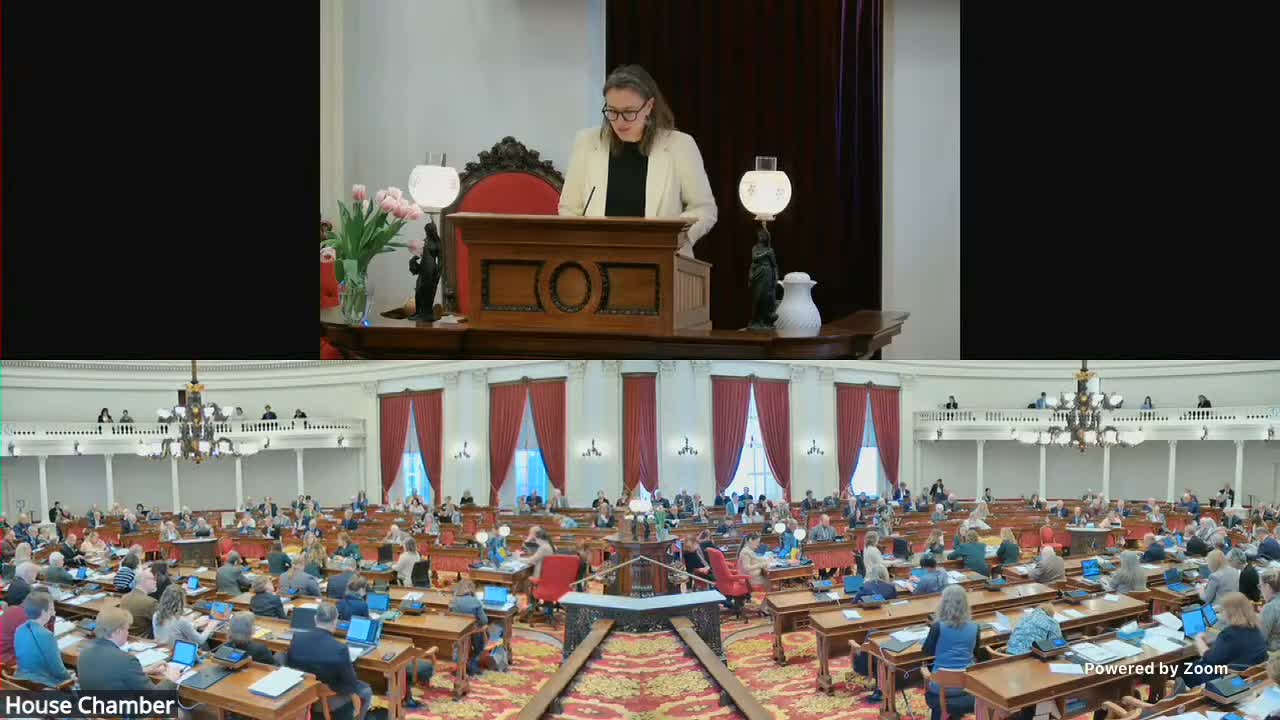
Summary
H.938 would establish a five-level Vermont Homelessness Response Continuum administered by the Office of Economic Opportunity, set definitions and time limits for shelter levels, require coordinated entry and case management, and provide a FY27 appropriation of about $82.6 million. The House advanced the bill with committee amendments and ordered third reading.
The Vermont House advanced H.938, a bill to establish a statewide Homelessness Response Continuum within the Office of Economic Opportunity and to provide initial implementation funding. Sponsors described a five-level model ranging from prevention and diversion to permanent supportive housing, with distinct definitions, prioritization rules, time limits, case management responsibilities and reporting requirements intended to reduce reliance on ad hoc hotel and motel placements.
The bill requires creation of statewide definitions for homelessness-related terms, separates shelter types into low-barrier and highly structured options, sets program time limits with narrowly defined exceptions, and directs the Office and community partners to build capacity and a unified continuum of care. The House companion language requires DCF to adopt emergency rules by July 1, 2026, with permanent rules by October 1, 2027; it also directs staging of full implementation through 2028.
Sponsors described significant reporting and accountability mechanisms: DCF must publish monthly and annual reports showing households served by level, average length of participation, transition rates, hotel/motel utilization and per‑level expenditures, and must set annual capacity and housing goals. The measure also creates a Vermont rental assistance bridge program and includes safeguards for domestic‑violence services.
Appropriations members described an initial FY27 funding package totaling $82,634,153 for services, shelter development and operations, rental assistance and supportive services. Floor sponsors presented a line-item breakdown in an amendment: approximately $39.2 million for housing opportunity grants (primarily shelter operations); $4.4 million for shelter development; about $32.39 million for hotel and motel emergency housing payments; $2.4 million for case management and community providers; $4.2 million for permanent supportive and family supportive housing; $3.0 million for the rental bridge program; $500,000 for municipal grants; $1.5 million for emergency cold-weather shelters; $3.16 million for staffing grants and contracts; and smaller items to round out the total.
Sponsors emphasized this is a phased implementation: emergency rules and initial spending start immediately upon passage, while grant and contracting requirements and certain rule-based provisions phase in through 2028 to allow systems, providers and regions time to build capacity. The bill passed committee votes and the House recorded a roll call on third reading business with the clerk announcing the ayes at 133; the House recessed afterward for lunch.
If enacted, the continuum would centralize program definitions, increase transparency about shelter use and expenditures, and require data-driven planning for shelter capacity and supportive housing investments across Vermont.