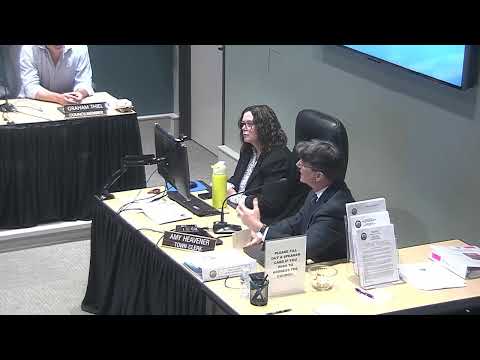
Moraga reviews parks master plan needs assessment; council presses on costs, parking and partnerships
Loading...
Summary
Consultants presented a parks, recreation and open-space needs assessment highlighting trails, a multigenerational community center and indoor fitness as top priorities; council and commissioners raised parking, topography and funding concerns and encouraged exploring joint-use agreements with Saint Mary's College.
Consultants from Wallace Roberts & Todd presented the needs assessment for Moraga’s parks, recreation and open‑space master plan at a joint meeting of the Town Council and Parks & Recreation Commission, describing both the community input process and preliminary opportunities for outdoor and indoor recreation.
Peter Winch of WRT said the project team completed a statistically valid mailed survey (415 responses) and extensive outreach including pop-ups and focus groups. He described Moraga’s current system as strong in passive recreation — open space, trails and scenic parks — but noted deficits in indoor recreation and certain active facilities. “We are here to share the needs assessment and look at preliminary recommendations,” Winch said, framing this meeting as an ideation step rather than a decision point.
Madison Merrill (WRT) reviewed key findings: Moraga has about 4.2 park acres per 1,000 residents (above the general-plan standard of 3 acres per 1,000), a unique trail network, and uneven distribution of amenities; ranked investment priorities from the survey included a community center, multi‑use trails and indoor fitness equipment. The consultants flagged site‑by‑site constraints — topography, parking and easements — and identified shortlists for fields, courts, dog areas and trails, plus seven candidate indoor/community-center sites.
On outdoor opportunities, consultants discussed the Moraga Commons back 40 and Rancho Laguna as the main locations for multi‑use fields, noting Rancho Laguna’s popularity with off‑leash dog users and the political sensitivity around changing its use. They also presented options for off‑leash dog areas on town land along Saint Mary’s Road and in the Commons back 40; consultants stressed tradeoffs in parking and access.
On indoor recreation, WRT recommended pursuing talks with Saint Mary’s College about joint‑use opportunities because the college’s existing facilities (gym, pool, courts) could be cost‑effective if community access terms can be negotiated. Consultants also examined Hacienda De Los Flores (the town’s current community building operated by a private vendor), JM Intermediate School orchard site, the Moraga Town Center parcel identified in the town plan, a linear park parcel along Saint Mary’s Road, and a public‑works staging area as options for different program priorities.
Council and commissioners spent much of the session pressing for clarity on parking, operations and likely capital and ongoing operating costs. Council member Teal asked for a prioritized approach with rough cost ranges and timelines for near‑term vs. long‑term options; other council members emphasized the need to evaluate staffing and maintenance implications and to avoid a “zero‑sum” framing that would pit existing users against new facilities.
Several speakers urged protection and expansion of the trail network, better signage and ADA/accessibility assessments. Commissioners recommended staff add maps of existing easements and regional partner trails (East Bay Regional Park District) to avoid omissions in planning.
Public commenters urged preservation of existing parks and trails, cautioned against changing Rancho Laguna Park without broad community support, and urged the town to consider smaller, near‑term improvements (restroom access, shade, signage) while pursuing longer‑term projects.
Town manager Scott said the next steps will include a community workshop, development of a draft master plan (targeted for August or September), and subsequent work on costs, phasing and potential funding approaches such as partnerships, grants or ballot measures. Consultants said the plan will include order‑of‑magnitude costs, phasing and implementation strategies once the council provides policy direction.
The meeting closed with encouragement from council and staff to continue public engagement and return with a draft plan that includes costs, timelines and clearer recommendations.