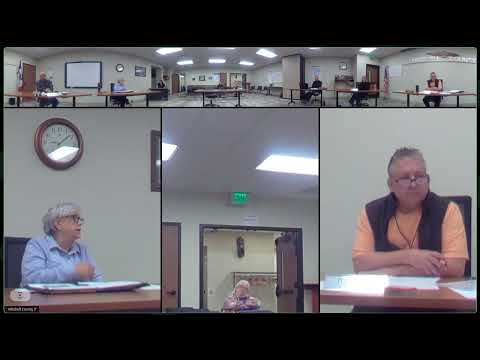
Mitchell County supervisors hold FY27 property tax levy hearing; residents seek clarity on mailings, pipelines and wind taxes
Loading...
Summary
At a March 30 Mitchell County Board of Supervisors public hearing on the proposed FY27 property tax levy, residents asked for clearer levy mailings, raised concerns about farm cash flow and potential carbon pipelines, and questioned how wind turbine taxes and TIF dollars affect local revenue.
Mitchell County supervisors opened a public hearing at 9:01 a.m. on March 30 to review the proposed FY27 property tax levy and answer residents’ questions about levy notices and local tax impacts. After a brief procedural approval of the agenda, the board invited public comment on the levy.
Several residents said mailed notices caused confusion about how to read the levy information. One attendee asked the board to explain the mailing format and how the levy figures translate into dollars for individual taxpayers. A participant who reviewed the paperwork said multiple households had received similar notices and that people were 'confused on the mailing.'
Board participants and staff described the levy components and provided basic rate figures. One speaker cited a technical component recorded as '2.14064' and the county rate was referenced during discussion as about '3.5395.' A participant who reviewed the numbers said one line item was 'actually going down $117,' while another combined urban line showed an increase of '$131,006.00,' prompting staff to clarify these represent changes in dollar amounts for particular assessed categories and that the levy rate itself was not being raised; the board confirmed the levy and associated tax calculations will take effect July 1.
Public commenters urged supervisors to consider local economic pressures, saying both residential and agricultural property owners are being 'squeezed' by higher costs and stressed that the board should be cautious when setting future tax requests.
Concerns about energy projects recurred during public comment. One resident said legislators had suggested a carbon pipeline 'sounds like it's coming' and asked how many miles it would cross in Mitchell County; a staff member said they previously had that information and would look it up and report back to the board. Residents also raised questions about perceived 'double taxation' on land hosting wind turbines. Staff explained how turbine value and base land value are assessed separately—described as distinct taxable components on the same acres—rather than overlapping taxes on identical value.
A county staff member said existing wind turbines in Mitchell County are inside tax increment financing (TIF) districts, and that TIF revenues have been used for capital projects; when a TIF district expires (roughly 20 years in the speaker’s example), the tax dollars would revert to the county’s general revenues. The speaker added that a company is seeking land access for additional turbines and reiterated that Mitchell County has a windmill ordinance that must be followed for each approved site and that projects could take one to three years to develop under local requirements.
On electricity, staff clarified that power generated locally is transmitted onto a larger grid and is not confined to county use, likening electricity markets to agricultural commodity markets where local production is sold broadly. The Chair noted differing legal and political developments in neighboring states about pipeline disposal that, in the Chair’s view, could affect whether a carbon pipeline is ultimately routed through the county.
With no further comments from the board, the Chair closed the public hearing at 9:13 a.m. The board did not adopt the levy at the hearing; staff said they would provide requested clarifications (mailing interpretation, pipeline mileage) and additional detail on specific levy line items and TIF status for follow-up.