Lifetime Citizen Portal Access — AI Briefings, Alerts & Unlimited Follows
Livermore council accepts 2025 housing element progress report; staff to submit to state by April 1
Loading...
Summary
After a public hearing and questions about deed restrictions and program counting, the Livermore City Council unanimously accepted the 2025 Housing Element annual progress report and directed staff to submit it to the state before the April 1 deadline.
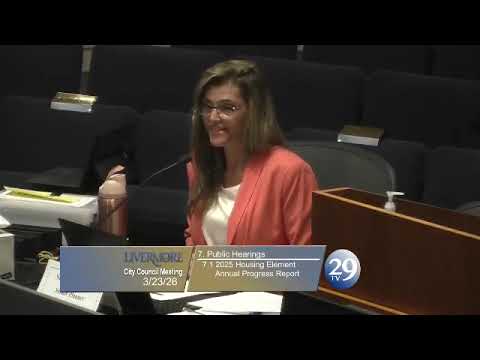
Shannon Pagan, the city’s senior planner, presented the 2025 Housing Element annual progress report Tuesday night, telling the Livermore City Council the document tracks housing production, program implementation and the city’s progress toward its Regional Housing Needs Allocation target of 4,570 units by 2031. Pagan said the report is state-required and will be submitted before the state’s April 1 deadline.
"Submitting this report to the state each year is required to keep our housing element in compliance with state law and to remain eligible for important housing related grants," Pagan said. She told the council that building permits in 2025 totaled roughly 422 new units across income categories and highlighted deeply affordable projects such as the Pacific Avenue senior apartments, which added about 75–79 units.
During the public comment period, Jean King asked several technical questions about the duration and treatment of deed-restricted units and whether Tri-Valley REACH projects were counted in the city’s APR. Shelly Haines of the city’s housing division said Tri-Valley REACH projects and other specialized housing are included in the annual progress report and confirmed that inclusionary units are deed-restricted while most ADUs are not (except some JADUs).
"Some that are inclusionary do require deed restriction; if there are units that are not deed-restricted, those are typically ADUs," Pagan said in response to the question about deed restriction terms. Council member Dunbar asked whether 55 years is the standard term for deed restrictions; Pagan and Haines confirmed 55 years is the typical current term.
Public commenters voiced a range of views. Alan Marling criticized local opposition tactics he said had delayed downtown affordable projects and alleged misinformation campaigns and lawsuits had impeded development. Matt Montero urged caution about relying solely on a "just build" approach, saying material and labor constraints can limit how quickly new units can be produced without additional funding.
Council members praised staff for compiling detailed data and noted the difficulty of meeting RHNA goals under current market conditions. Council member Branning said Livermore is making comparatively good progress but emphasized that state funding constraints and market forces make it challenging to meet low-income targets. Mayor Marchand and others underscored the city’s role in zoning and enabling development while noting the city does not directly build housing.
After discussion, Council member Dunbar moved and Council member Branning seconded a resolution accepting the 2025 Housing Element annual progress report. The council voted unanimously to adopt the resolution. City manager Mariana Birch confirmed staff will submit the report to the state before the April 1 deadline.
Votes at a glance: the council approved the consent calendar unanimously earlier in the meeting and later approved formation of an ad hoc subcommittee on regular repavings and Isabel neighborhood transportation implementation; Council members Branning and Dunbar were named to that single-purpose subcommittee.
What happens next: staff will file the adopted annual progress report with the state by April 1 and continue implementing housing element programs, including pursuing grant funding and monitoring permitted and entitled projects that will contribute toward the RHNA target.