Judiciary Committee approves bill shifting initial filings by private complainants from arrest warrants to summonses
Loading...
Summary
The Judiciary Committee voted to report House Bill 336 as amended, which lets district court commissioners issue criminal summonses (instead of initial arrest warrants) on applications for statement of charges filed by non-law-enforcement applicants; the state's attorney must review such summonses within 72 hours and may ask a judge to convert a summons to an arrest warrant if there is good cause.
The Judiciary Committee on March 1, 2027 approved House Bill 336 as amended, changing how applications for criminal charges filed by private individuals are handled. Under the amendment, a district court commissioner may issue a criminal summons — a court appearance notice — when an application for a statement of charges is filed by someone who is not a police officer or a state's attorney; commissioners may not issue an arrest warrant under that provision.
Claire, explaining the amendment for the committee, said the commissioner's role is limited: "On review of such an application, a district court commissioner may issue a summons if the commissioner determines that there is probable cause that the defendant committed the offense or offenses charged in the charging document." She added that if a commissioner finds probable cause that the defendant poses a danger to another person or to the community, the case must be referred to the state's attorney for review.
The amendment requires the state's attorney to review a referred summons "as soon as practicable, but no later than within 72 hours" and determine whether to ask a judge to issue an arrest warrant. The bill also preserves existing safeguards: a judge may convert a summons to an arrest warrant on a finding of good cause, and victims are to be given access to information about whether an arrest warrant was later issued in response to an application filed by the complainant.
Committee members pressed on practical concerns. "So today, what it how does this differ today versus what we're doing here?" asked Delegate Moon, raising a rural, after-hours scenario in which a victim seeks immediate protection. The chair and other members noted victims retain options: police can still make warrantless arrests, a commissioner can be asked to issue an arrest warrant in appropriate circumstances, and the 72-hour review is triggered when the state's attorney receives the summons. Delegate Phillips cautioned against overstating the effect of the change, saying that "most warrants for arrest are not effectuated within the 72 hour time frame" based on information shared with the committee.
Members also debated the bill's reporting requirements and data feasibility. The amendment adds reporting obligations, including that final dispositions be reported for arrest warrants issued; the chair said some complainant-level data cannot be provided due to court privacy limitations and that defendant demographic information would be self-reported. Delegates suggested tracking repeat filings by the same complainant to identify serial complaints, but the chair said courts do not currently provide aggregated complainant tracking and additional programming would be needed.
The committee adopted a drafting clarification suggested by Delegate Embree: the state's attorney should review the application for a statement of charges (the charging documents) rather than the summons notice itself. Members also discussed whether the measure should be made emergency legislation; the chair said an emergency designation was not pursued because systems and forms will need to be updated and because the bill's effective date is October 1.
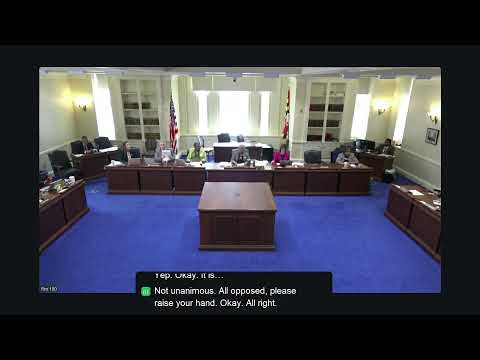
After discussion, the committee voted to report the bill favorably as amended. The clerk read the roll and announced the tally: 16 yes, 1 no, 0 abstentions, 1 absent and the motion carries. Several delegates asked to be added onto the legislation as sponsors. The committee meeting concluded with the bill advanced to the next stage of consideration.