Get Full Government Meeting Transcripts, Videos, & Alerts Forever!
Get email alerts on the Tax Exemptions topic
No spam. Unsubscribe anytime.
Kings Park board reviews new state tax-exemption rules; assessor estimates about $90 annual impact per household for senior change
Summary
The board held a public hearing on four recent state exemptions. Superintendent Dr. Egan said two do not require board action (100% disabled veterans mandatory; active-duty combat-zone exemption applies only to town tax), while a surviving-spouse exemption and a senior-income amendment may require local opt-in; the assessor estimated about a $90 annual average increase for remaining taxpayers if the senior change is adopted.
The Kings Park Central School District held a public hearing before its March 10 meeting to explain four tax-exemption changes signed into law at the state level and to clarify which require local action.
Superintendent Dr. Egan told the board the governor signed several amendments in December and that the district wanted to walk residents through which exemptions would affect school taxes. "If we do have any 100% disabled veteran in King's Park, they will get this exemption," he said, noting that the 100% service-connected disability provision is now mandatory for school districts and requires no board action. He added that an active-duty military exemption for service in a combat zone applies to the town portion of property tax and not to school taxes, so it likewise requires no district action.
Two of the recently enacted items do require consideration at the district level, Dr. Egan said. One covers surviving spouses of police officers, volunteer firefighters and volunteer ambulance workers killed in the line of duty and allows a maximum exemption for surviving spouses. The other is an amendment to the district’s existing senior citizen exemption. "The assessor has predicted that given the number of folks that would potentially be eligible for this exemption, the rest of the pool, the typical residents would see about a $90 increase to their school taxes if this exemption is adopted," Dr. Egan said.
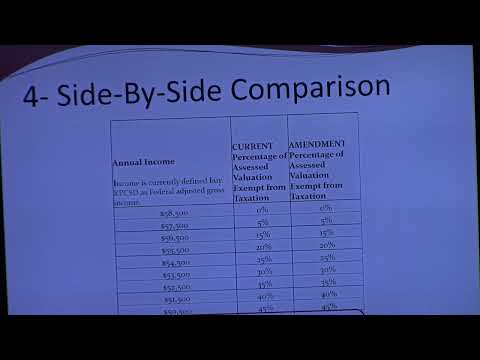
Dr. Egan walked through the proposed senior-exemption changes, saying the maximum exemption in the revised schedule would increase from the current top level (50% in the district's existing schedule) toward a higher maximum (65% at lower income tiers) while shifting income thresholds for eligibility. He cautioned the exact income breakpoints were displayed in a slide and that the board would have more time to consider a formal resolution at a future meeting.
Board members and the administration emphasized the mechanics of administration: the town assessor processes applications, the district consults town legal counsel, and any adoption by the board would affect how the remaining tax burden is distributed among taxpayers. Dr. Egan said deadlines mean any change would not take effect for the coming school year but would apply for the 2027-28 tax roll if adopted in the required timeline.
No formal motion on the exemptions was taken at the hearing; Dr. Egan closed the public comment and directed the board to consider a resolution at a later meeting.
The board plans to circulate further details, including clearer income thresholds and modeled fiscal impacts, before any vote so residents can see the distributional effects and the timeline for implementation.