Get Full Government Meeting Transcripts, Videos, & Alerts Forever!
Get email alerts on the Federal Appropriations topic
No spam. Unsubscribe anytime.
Senator seeks immediate passage of Murray bill to fund TSA, Coast Guard and FEMA; colleague objects
Summary
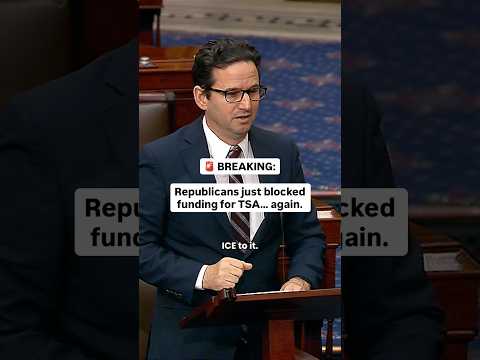
A senator asked the Senate for unanimous consent to pass a "Murray bill" to restore funding to TSA, the Coast Guard, FEMA and cybersecurity programs, calling the agencies "hostages" in an ICE funding dispute; another senator objected and said they would offer an alternative.
A senator on the Senate floor asked colleagues to quickly pass a measure he identified as the "Murray bill" to restore funding to several federal agencies, arguing unrelated programs were being held "hostage" in a dispute over immigration enforcement funding.
The senator said many frontline agencies had been excluded from recent appropriations actions: "They won't fund TSA. They won't fund Coast Guard. They won't fund FEMA," and asserted that cybersecurity funding was conditioned on attaching ICE-related provisions. He added that workers at those agencies were suffering immediate harm: "These are American citizens working for the government, working for the public without a paycheck," and urged colleagues to "release the hostages." The senator also noted that roughly "96% of the government is now funded," listing the Defense Department, State Department, the National Institutes of Health, the Centers for Disease Control, the Department of Energy and the Department of the Interior as already funded.
The senator formally sought unanimous consent that the Senate "proceed to the immediate consideration of the Murray bill that is at the desk, that the bill could be considered read 3 times and passed, and that the motion to reconsider be considered made and laid upon the table." That request would have allowed the Senate to pass the measure without further debate if no colleague objected.
Another senator objected. "I do object to this, but I'd love to be able to offer an a second alternative to this in the days ahead. So I object," the second senator said, preventing the unanimous-consent request from succeeding. The objection means the measure could not be adopted by unanimous consent at that moment and would instead require regular Senate procedures to reach a vote.
No formal vote on the Murray bill occurred during the exchange. The objecting senator indicated an intent to propose an alternative approach in the coming days. The immediate outcome was that the unanimous-consent motion failed because of the objection; the Senate did not proceed to consider the bill at that time.
Next steps were not recorded in the transcript excerpt. The dispute centers on whether funding for immigration-enforcement measures should be linked to continuing appropriations for agencies that several speakers said are unrelated to that policy fight.