Saint Petersburg and Pinellas County Schools outline partnerships to boost literacy, youth programs and workforce pathways
Loading...
Summary
At a Pinellas County Schools "listen and learn" in St. Petersburg, district and city leaders highlighted partnerships—City Reads, mentoring, apprenticeship pathways and youth outreach programs—and set timelines for a disengaged-youth study that city staff said will be released later this year.
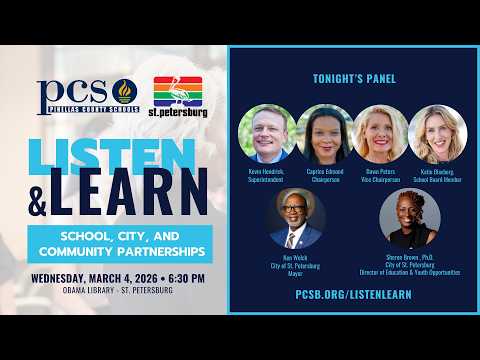
Estine Dawe, director of strategic partnerships for Pinellas County Schools, opened the community "listen and learn" at the Barack Obama Library and framed the evening as a chance for residents to connect directly with district leadership and city partners.
"The purpose of the listen and learn series is to provide stakeholders of Pinellas County with the opportunity to engage with the school board superintendent and district leadership," Dawe said, before turning the mic over to Superintendent Kevin Hendrick and city officials.
Superintendent Hendrick highlighted district performance and a long list of external partners that support classroom and out-of-school programs. "We have seniors in service, lawyers for literacy, our Big Brothers Big Sisters connection, the City Reads program," Hendrick said, adding that nearly 90% of Pinellas schools are rated A or B and reporting a graduation rate of 93.4 percent for last year's graduates.
City officials said municipal programs are designed to fill gaps around early literacy, summer and after-school engagement and workforce preparation. "City Reads" was held up as a model in which city employees adopt a school and read to preschool children; the city also circulated an early-literacy resource guide and described a "Friday Flex" program that extends safe activities at recreation centers on Friday evenings.
Dr. Sharron Brown, the city’s director of education and youth opportunities, described a set of new and expanding initiatives, including a teen resource fair, Camp Bullseye (a residential middle-school experience) and a high-school–focused program launching in August that will serve Gibbs, Boca Ciega and Lakewood. Brown also emphasized outreach to disengaged youth: "Research shows that there are 3,000 disengaged youth in the city of Saint Petersburg," she said, and added that the city has nearly 1,200 students participating in a study to inform outreach strategies.
Both city and district leaders stressed mentorship as a pressing need. Board members and the superintendent reiterated that community partners provide critical services—mental-health supports, mentoring and after-school programming—that the district could not fully fund on its own.
The session included practical steps for organizations that want to partner with schools: district staff advised working directly with individual schools (which can host tables at events, set up in cafeterias or include partners in parent nights) and noted screening requirements such as fingerprinting for volunteers.
The apparent takeaway: city and district leaders framed future progress as dependent on coordinated partnerships—ranging from volunteer reading programs and mentoring to apprenticeship pipelines and joint housing efforts for school employees—while promising public release of key research and continuing community forums.
The listen-and-learn recordings and archived materials are available on the district website for those seeking details and next steps.