Get Full Government Meeting Transcripts, Videos, & Alerts Forever!
Get email alerts on the Wrc Preparation topic
No spam. Unsubscribe anytime.
Senators press for early U.S. leadership, security measures ahead of 2027 World Radio Conference in Shanghai
Summary
Senators and expert witnesses told the Senate Commerce Committee that the United States must appoint a delegation leader early, unify interagency positions, and take cybersecurity precautions before the 2027 World Radio Conference in Shanghai to protect spectrum critical to national security and commercial innovation.
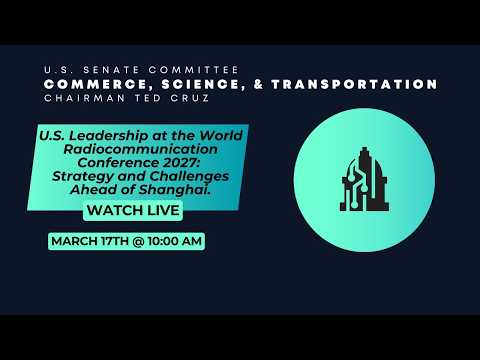
The Senate Committee on Commerce, Science, and Transportation heard bipartisan calls on March 24 for early, disciplined U.S. preparation for the 2027 World Radio Conference, with witnesses warning that China’s selection as host and a fragmented interagency process could threaten U.S. spectrum interests and national-security systems.
Ambassador Grace Ko, a former head of the U.S. delegation to WRC 2019, said the United States must “start early,” and urged naming the head of delegation and staffing the team to cover parallel sessions well before the conference. She warned that Shanghai adds “operational and political risk,” including the likelihood that “devices, communications may be monitored” and that common U.S. collaboration tools could be unreliable, recommending clear guidance on cybersecurity and export compliance.
“The World Radio Communication Conference is among the most technically complex treaty negotiations in the world,” Ko said, arguing that consensus is essential and that a narrow vote would risk noncompliance and increased interference.
Ambassador Stephen Lang, who led the U.S. delegation to WRC 2023, said China’s role as host and the prospect that a Chinese official will chair parts of the conference raise “information-security” concerns but should motivate the U.S. to accelerate preparations and build coalitions. “We must continue to hold China accountable and press like-minded partners to do the same,” Lang said, urging an early diplomatic push and the identification of delegation leadership so the United States can engage regionally and globally.
Dr. James Lewis of the Center for European Policy Analysis emphasized that space- and LEO-related issues dominate the agenda, noting that China submitted filings in late 2025 for a large number of satellites and that some proposals effectively seek greater national control over satellite operations. He said those filings and sovereignty-driven proposals could undercut U.S. commercial satellite operators unless countered with technical study and diplomacy.
Michael Calabrese of New America focused on defending unlicensed uses, particularly Wi‑Fi in the 6 GHz band, and on modernizing ITU sharing rules for LEO satellites. Calabrese warned against proposals to reallocate 7.4–8.4 GHz to international mobile telecommunications (IMT) for certain regions and said the U.S. should resist changes that would undermine recent statutory protections.
Senators across the aisle pressed witnesses on several recurring themes. Ranking Member Senator Luhan said the U.S. must “engage in the lead up to the conference with clarity and purpose,” underscoring the need for the White House, FCC, NTIA and State to coordinate. Senator Blackburn recounted the difficulties of a truncated preparation cycle in 2023 and asked what it meant operationally to step in late; witnesses described lost diplomatic opportunities and stressed the value of early regional engagement. Senator Rosen focused on the economic stakes for Wi‑Fi and the broader tech sector if the U.S. fails to protect the 6 GHz band.
Committee members and witnesses repeatedly distinguished discussion from formal action: this hearing produced recommendations rather than votes. The chair noted that Congress had recently exempted the 7.4–8.4 GHz band from FCC auction authority, a statutory protection witnesses said should anchor U.S. positions at WRC 27.
The witnesses’ consistent prescription was early, public identification of a head of delegation, unified interagency positions, robust diplomatic coalition-building, and concrete operational planning — including cybersecurity protections and contingency planning for working in Shanghai. Senators set deadlines for questions for the record (close of business March 24) and gave witnesses until April 7 to respond.
The committee adjourned with a directive to translate the hearing’s recommendations into concrete preparatory steps so the United States arrives in Shanghai with a cohesive, well-staffed delegation.