Get Full Government Meeting Transcripts, Videos, & Alerts Forever!
Get email alerts on the Community Culture topic
No spam. Unsubscribe anytime.
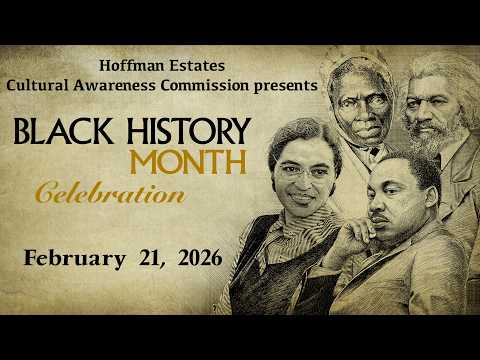
Hoffman Estates program spotlights African and Latin American contributions with music and school performances
Summary
The Hoffman Estates Culture Awareness Commission hosted a Black History Month program featuring Mayor Bill McLeod, a four-part presentation on architecture, fashion, genetics and music by Chris Flaxshare, performances by the Funk Brothers and the Hoffman Estates High School majorettes, and acknowledgements of local volunteers.
Hoffman Estates — The Culture Awareness Commission’s Black History Month program in Hoffman Estates brought local officials, performers and a multimedia presentation that traced African and Latin American influences in architecture, fashion, genetics and music.
Mayor Bill McLeod opened the afternoon by thanking the commission and community volunteers and noting the broader historical context. “We always have to remember that the history of everybody who is here … is all part of American history, as is black history,” he said, and he asked attendees to recognize community partners and volunteers who helped organize the event.
The program’s central presentation was delivered by Chris Flaxshare, introduced by the MC as nicknamed “Chubb.” Flaxshare divided his talk into four parts: the influence of African and Mesoamerican pyramids and obelisks on modern architecture; traditional African and Latin American clothing and braiding practices; historical figures who illustrate African heritage in the Americas; and musical forms that traveled from Africa to the Americas. “The braids are very prevalent … coming from the Yoruba, Igbo, Masai, Fulani, Bantu tribes,” Flaxshare said while showing images and describing regional garments such as kente cloth.
Flaxshare also said state-level policy changes have reduced training requirements for some African hairstyling certifications, telling the audience that a previous 3,200-hour requirement was “excessive” and that the Mississippi governor had signed legislation to reduce those hours; he added that Illinois is considering similar changes. The presentation did not provide statute names or specific citation details for those laws; those particulars were not specified during the talk.
Musically, Flaxshare highlighted rhythmic drumming, coordinated movement and call-and-response singing as through-lines from African traditions into contemporary U.S. genres and HBCU (historically Black college and university) halftime performances. He referenced Florida A&M University’s marching and drumming traditions as an example of synchronized movement and complex cadences.
The program also included live music and dance: the Funk Brothers performed earlier in the program, and the Hoffman Estates High School majorettes, Orange Crush, gave two routines including one created for Black History Month. Organizers closed by thanking community partners, including Alpha Kappa Alpha and the Schaumburg Township District Library, and encouraging continued participation in cultural events.
The event served as a local observance of Black History Month rather than a policy forum; presenters combined historical narration, cultural education and live performances. Organizers said the program would continue with additional performances during the afternoon and concluded with thanks to volunteers and attendees.