Get Full Government Meeting Transcripts, Videos, & Alerts Forever!
Get email alerts on the School Calendar topic
No spam. Unsubscribe anytime.
Policy committee debates four-day school week while approving Head Start update and student trip
Summary
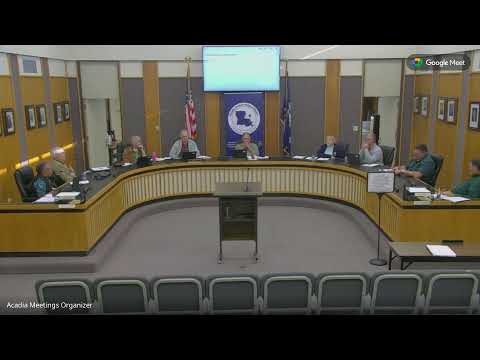
At a policy committee meeting the board heard a Head Start monthly report, approved an Evangeline Elementary trip to NASA, and engaged in an extended debate over the four-day school week, with members disagreeing on impacts to student achievement, teacher retention and community cohesion.
The Acadia Parish policy committee convened for reports and policy discussion, hearing a Head Start update, approving an out-of-state student trip and holding an extended debate about the district’s four-day school week.
A Head Start representative presented the monthly summary: spring class observations had been completed, teaching staff were reported at the proficient level, school-readiness goals emphasize family engagement and transition support, and spring dental screenings were conducted at Head Start centers in Ross, Church Point and Rain. Enrollment for Head Start was reported at full capacity of 314.
The committee then approved an out-of-state travel request for students from Evangeline Elementary to visit NASA in Houston on May 11, 2026. The motion was recorded in the meeting as moved by Milton and seconded by Atkinson, and the committee approved the trip on a voice vote.
The bulk of the session was devoted to the four-day school week. Several members cited national research and local performance data. One committee member referenced a nationwide study that, they said, showed little impact for rural schools but lower student performance in nonrural systems that adopted four-day schedules; that speaker suggested the parish’s urban communities (Crowley, Rain and Church Point) may be at risk of lower scores. Other members cautioned that the four-day week has helped with teacher recruitment and morale, argued the district must weigh instructional minutes and community supports, and noted differential pay allocations or targeted stipends could be explored as recruitment tools. Staff said they had asked the state education department about whether differential pay allocations can be restructured or rolled over to support targeted recruitment but had not yet received a response.
No motion to change the calendar was recorded; committee members acknowledged that the 2026–27 calendar will operate on a four-day schedule as currently proposed. Members asked staff to pursue follow-up information on differential-pay flexibility and measures to monitor instructional minutes and student outcomes.
The committee closed after members encouraged community engagement to support struggling campuses and to consider targeted recruitment and retention incentives.