Buncombe County Schools outlines $152M in priority requests, urges cash flow for W.D. Williams while bond is pending
Loading...
Summary
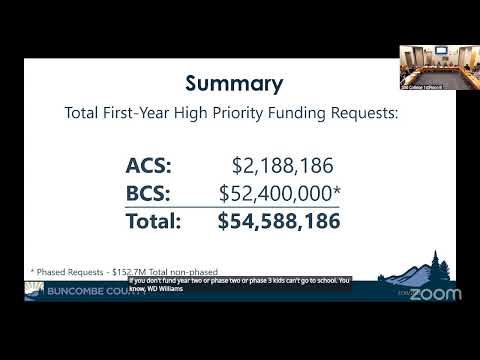
Buncombe County Schools presented a grouped list of roughly 40 capital requests and highlighted W.D. Williams as an urgent construction priority—district officials said they will run out of funds this summer unless additional cash flow is provided; the district also urged a November bond referendum to refinance Article 39 and support major projects.
Buncombe County Schools presented its priority list to the School Capital Fund Commission on March 30 and pressed the commission to consider short-term cash flow to avoid construction stoppage at W.D. Williams while a potential November bond remains uncertain.
The district’s presenter (speaker 6) summarized system scale and multiple requests grouped for presentation convenience, then singled out W.D. Williams as the most time-sensitive item. “We we are currently under construction, but by the summer, we will be out of funding and have to either stop the job or…,” the presenter said, explaining that while a phased $2,000,000 allocation is on the commission’s list, the district said it would need substantially more cash now to keep work moving and avoid escalation.
Presenter and commissioners discussed the prospect of a general-obligation bond on the November ballot that, if approved, could refund Article 39 and repay the school capital fund. Staff said a successful bond could be marketed next spring and proceeds sold by the end of the fiscal year, but commissioners asked the district to model realistic cash-flow and bid/timeline scenarios before committing additional commission funds.
Buncombe also described system-wide needs including a network-infrastructure backlog (the presenter said a multi-year backlog could amount to $30–40M), numerous roof and mechanical-system replacements, playground replacements, bus-facility work, ADA upgrades, and other life-cycle maintenance items. The district said it is prioritizing critical safety and capacity projects and requested the commission consider phasing versus full funding strategies to minimize the risk of disrupted construction or inflated future costs.
Commission members requested a five- to ten-year cash-flow plan that identifies which projects are suitable for debt funding, which can be pay-go, and how bond proceeds would change the commission’s obligations. The commission did not approve additional cash at the meeting but requested detailed modeling and cost breakdowns for follow-up.