Get Full Government Meeting Transcripts, Videos, & Alerts Forever!
Get email alerts on the Public Safety Facility topic
No spam. Unsubscribe anytime.
Consultants tell San Gabriel council police station fails modern seismic and space standards; options range from $24M to $87M
Summary
A Griffin Structures needs assessment found San Gabriel’s 1961 police building has structural, ADA and space deficiencies and recommends options from limited renovation (~$24M) to new construction (~$87M); consultants urged the council to treat the presentation as informational and to return with funding and delivery choices.
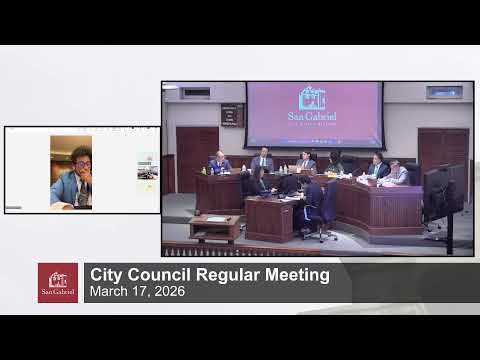
The San Gabriel City Council on March 17 received a facility needs assessment for the city’s police department that concluded the main building—originally built in 1961—does not meet current seismic standards for essential-service facilities and is constrained in space and building systems.
Dustin Alamo, vice president of Griffin Structures, told the council the site uses roughly 16,500 square feet now, but ‘‘the department would require approximately 32,500 square feet for that baseline future need and nearly up to 40,000 square feet for a best practice’’ program, which would add training, storage, a range and other support functions. He also said the building’s facility condition index is about 15%, ‘‘placing it near a threshold where facilities are considered to be nearing the end of their serviceable life.’’
The assessment presented five conceptual options. Jeremy Hart of LPA Design Studios described the range: renovation alternatives that include constructing a parking deck (Option A) or rearranging support buildings (Option B); a single-building expanded renovation (Option C); full demolition and new construction (Option D); and a limited, footprint-constrained renovation (Option E). Preliminary all-in cost estimates presented by Griffin are roughly $66 million–$79 million for renovation scenarios (some including a deck), about $87 million for new construction and approximately $24 million for a minimal scope limited-renovation option. The consultants said budget figures reflect February 2026 pricing and include contingencies and soft costs.
City Attorney Keith cautioned that the item was posted as ‘‘not a project’’ under California environmental rules because the council was not being asked to select a specific project at this meeting; staff characterized the session as a workshop to gather direction and identify additional information needed. ‘‘You’re receiving the report,’’ Keith said; ‘‘you’re not making a decision tonight.’’
Council members pressed consultants on trade‑offs: Vice Mayor Chan and others asked how operations would be maintained during work; consultants recommended planning for temporary modular facilities or partnering with neighboring agencies for services such as dispatch. On holding cells, the consultants confirmed none of the five options includes a jail; Captain Ricky Nakamura told council that prior plans had proposed a regional jail but the department and chief prefer not to house prisoners on-site because of liability and operational complexity and that the city currently uses a regional partner for detention.
Council members also asked about parking and subterranean options; Alamo said underground parking was not in the study due to substantially higher costs (often at least double an above-ground deck). The team noted code and sustainability implications: the California green building code requires certain green energy measures for public safety buildings, so solar panels and battery backup would be expected in the final design.
Staff and the consultants recommended that the council ‘‘receive and file’’ the needs assessment and return with direction about preferred options, funding strategies and a procurement/delivery approach. Mayor Menchaca and other members indicated they want more detail on financing and staging before choosing a path forward. The report will be returned to council with additional analysis at a later date.
The presentation—and the decision to treat it as information only—passed with no formal selection of an option at the March 17 meeting.