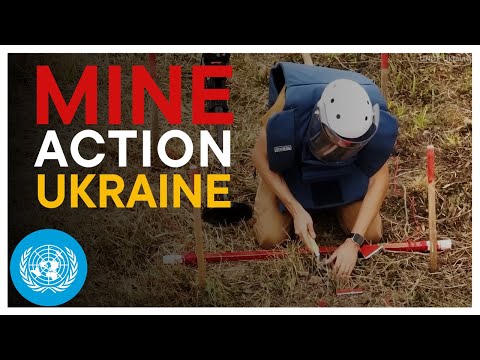
UNDP official: about 132,076 sq km of Ukrainian land contaminated; agency outlines clearance plans
Loading...
Summary
A UNDP official described widespread contamination in Ukraine—about 132,076 square kilometers of land and roughly 14,000 square kilometers of water—and outlined UNDP support including an AI prioritization tool (GRIT), training veterans for mine action, use of technical survey dogs, and support for commercial mine-action and local industry.
An Agency official from the United Nations Development Programme (UNDP) said Ukraine has been contaminated since the Second World War and that contamination has grown with the recent conflict. “Ukraine has been contaminated since the second World War,” the official said, adding that “very heavily, and all of Ukraine pretty much is contaminated in some way or other.”
The official cited the latest figures for the scale of contamination: “The latest figure of contaminated land is about 132,076 square kilometers,” and “also, 14,000 square kilometers of water” are affected, according to the UNDP representative. The speaker said frontline areas and occupied territory behind front lines are contributing to increasing contamination on a daily basis.
The UNDP official described three main areas of UNDP’s response. First, on governance, the agency supports national authorities’ coordination and management capacity. “So our role as UNDP is really to support national authorities in terms of their ability and capability to coordinate, manage,” the official said.
Second, the official described a data-driven prioritization tool called GRIT (spelled out by the speaker as “g r I t”), which uses artificial intelligence to combine agricultural land-use data and physical contamination information and, through an algorithm, prioritizes land that should be cleared. “It’s based on artificial intelligence, and it’s a system which takes data on agricultural land use, physical contamination, and through an algorithm, prioritises land that should be cleared,” the speaker said.
Third, on physical capacity, UNDP said it trains predominantly disabled veterans (with attention to gender balance) to work in humanitarian mine action. The official also said UNDP is introducing technical survey dogs that the speaker distinguished from mine-detection dogs, describing them as “a step further” and “more flexible.”
The UNDP representative said the agency also supports the commercial mine-action sector in Ukraine and seeks to stimulate Ukrainian industry to produce machinery and equipment used in clearance. “We are supporting the commercial mine action sector in Ukraine and also stimulate Ukrainian industry in the sense of producing machinery and equipment,” the speaker said.
The speaker did not provide a timeline for clearance operations or specify budgets and said details on implementation sequencing and specific sites were not given in the remarks. The remarks focused on the scale of contamination and UNDP’s areas of support: governance and coordination, AI-driven prioritization (GRIT), capacity building through veteran training, new survey-dog capabilities, and industry support.