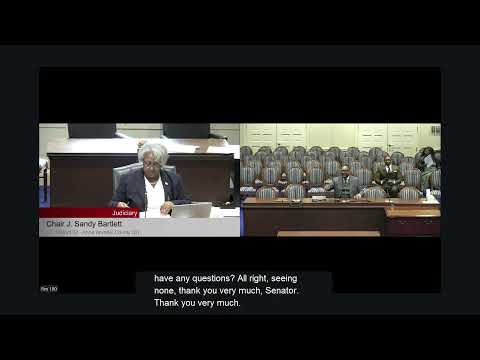
Committee hears testimony for proposal to elevate some stalking cases to felonies
Loading...
Summary
SB512 would make stalking a felony when the offender is on notice (prior conviction, active protective order or out‑of‑state conviction); prosecutors and advocates gave case examples and statistics linking stalking to later lethal violence, while members questioned sentencing effects and overlap with probation and victim protections.
Sen. Will Smith presented SB512, which would enhance penalties for stalking in specified circumstances: when the defendant has a prior stalking conviction, when a protective order was in effect, or when there is an out‑of‑state stalking conviction. "Stalking has also a high correlation to homicide," Sen. Smith told the committee, citing statistics about prior stalking among female homicide victims.
Debbie Feinstein, chief of the special victims division for the Montgomery County State's Attorney's Office, described multiple local cases to illustrate how repeat stalkers continued dangerous conduct even when subject to protective orders or on pretrial conditions. "He broke into her home 2 times while the protective order was active... He was charged with stalking and yet he faced 5 years — which is not a crime of violence," Feinstein said, arguing existing misdemeanor penalties can be inadequate for persistent offenders.
Lisa Jordan of the Maryland Coalition Against Sexual Assault supported the bill and emphasized the link between stalking and later physical or sexual violence, particularly in intimate‑partner contexts. Committee members probed how enhanced penalties interact with parole eligibility, violation of probation outcomes, and treatment or intervention programs. Feinstein said jurisdictions already use abuser‑intervention programs and probation conditions, but persistent offenders sometimes continue despite interventions.
The committee received detailed operational questions about sentencing, parole, and what prior conduct (convictions vs. allegations) can be used to enhance penalties. Proponents argued the bill is narrowly tailored to those on notice and urged a favorable report.