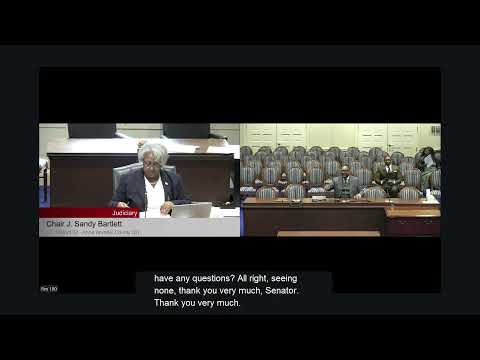
House Judiciary hears bill to curb automatic adult charging for youth, sponsor urges cautious compromise
Loading...
Summary
Sen. Will Smith presented SB323 to narrow offenses that automatically start youths in the adult system, citing Maryland's JJDPA noncompliance, racial disparities and public‑safety costs. Lawmakers pressed on retained exceptions for 14–15‑year‑olds and implementation impacts on juvenile services.
Sen. Will Smith returned to the House Judiciary Committee to present SB323, a bill that would curtail automatic adult charging for juveniles and shorten how often Maryland's cases fall out of compliance with the federal Juvenile Justice and Delinquency Prevention Act. "We have more infractions than any other state in the union, over 1,600 last year," Smith said, arguing the change would save money and improve outcomes for youth.
The bill removes several offenses from the list that currently triggers automatic adult charges and preserves judicial waiver and adversarial transfer hearings so a prosecutor, defense counsel and judge decide the appropriate forum. Smith said the proposal would help address stark racial disparities: "9 out of 10 of those youths charged as adults are children of color; 8 out of 10 are Black children."
Committee members pressed the sponsor on which offenses remain. The vice chair asked whether first‑degree murder and attempted first‑degree murder remained auto‑charged for 14‑ and 15‑year‑olds; Smith confirmed those narrow exceptions are retained. Other delegates sought operational details: Delegate Phillips asked whether the change would provide the Department of Juvenile Services time to demonstrate capacity, and Smith said the bill would permit a proof‑of‑concept that could support wider reform.
Smith acknowledged tradeoffs: he said the bill was a negotiated compromise that stripped a small number of categories (including a seldom‑used sawed‑off shotgun provision) to secure a fragile coalition in the Senate. "This reform is long overdue," he said, but urged lawmakers to weigh the political and practical risk of reopening the bill at the end of session.
The committee heard questions about repeat offenders and mandatory holds for certain arrests; Smith said the legislation codifies current DJS hold practice to balance public safety and individualized judicial decision‑making. The sponsor asked for a favorable report and stood by for committee action.
What comes next: the committee may amend the cross‑file and decide whether to send the bill back to the Senate for further negotiation. If adopted, the bill would change which charges start youths in adult court while preserving transfer hearings and judicial discretion.