Get Full Government Meeting Transcripts, Videos, & Alerts Forever!
Get email alerts on the Housing Affordability topic
No spam. Unsubscribe anytime.
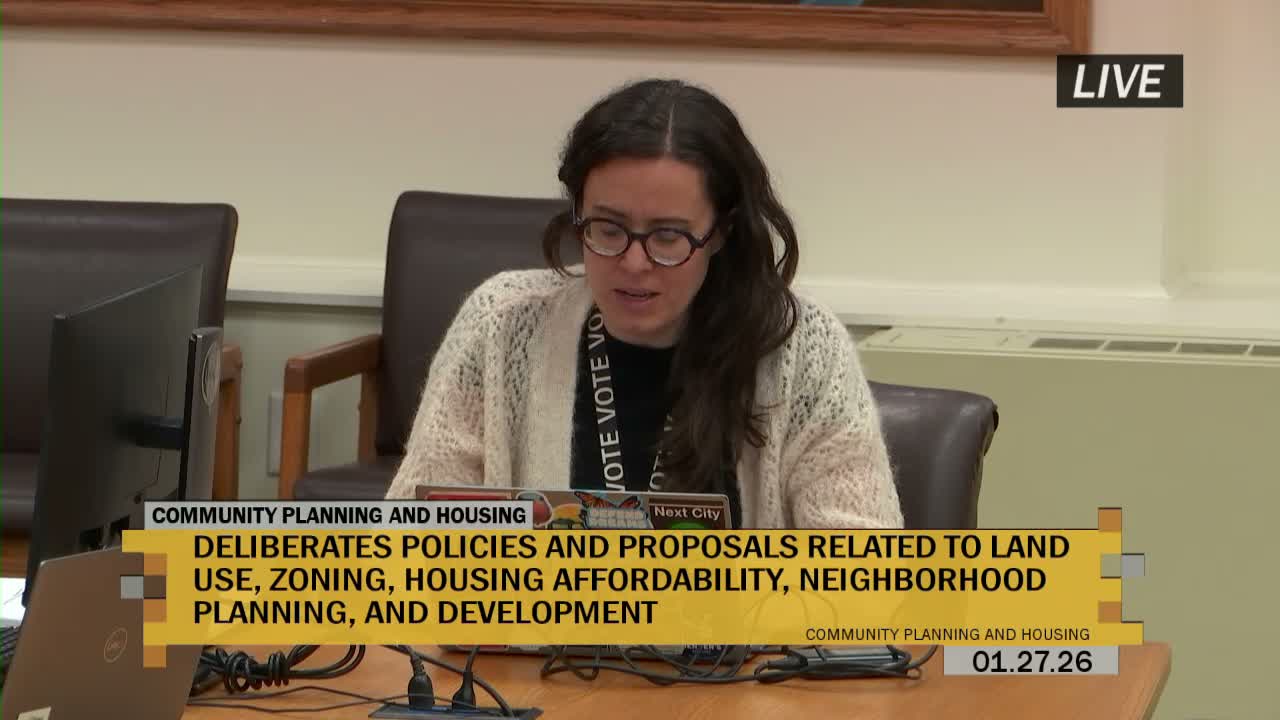
Community Planning and Housing Committee advances rezoning for four affordable homes in Elyria–Swansea
Summary
The committee voted by voice to forward rezoning case 26062 to a March 9 City Council public hearing, clearing the way for Tierra Collectiva and a community land trust to build four income-restricted row houses on a remnant parcel affected by the I‑70 expansion. Council and applicants discussed parcel size, acquisition funding and homeowner eligibility.
The Community Planning and Housing Committee of the Denver City Council on Tuesday voted by voice to forward rezoning case 26062 to a March 9 City Council public hearing, a step intended to allow Tierra Collectiva and an affiliated community land trust to develop four permanently affordable homeownership row houses on a remnant parcel in the Elyria–Swansea neighborhood.
Councilmember Watson framed the rezoning as an act of repair for neighborhoods damaged by past highway construction, saying, “This rezone ... is about repairing harm, restoring housing and keeping neighbors rooted in Elyria and Swansea communities.” City Planning and Development staff recommended approval to move the application forward, finding the request consistent with Blueprint Denver, the Comprehensive Plan 2040 and the Elyria–Swansea neighborhood plan.
Ed, a planner with City Planning and Development, described the request as a change from a former Chapter 59 PUD to URH 2.5 (row house up to 2.5 stories) and said the parcel is vacant after being affected by the I‑70 expansion. He told the committee the site is surrounded by primarily single- and two‑unit residential zoning and that CPD’s staff report concluded the proposal meets the three rezoning review criteria: consistency with adopted plans, public interest and neighborhood context.
Nola Miguel, executive director of the GS Coalition and Tierra Collectiva Community Land Trust, told the committee the organization worked with CDOT and congressional-designated funds, coordinated through Senator Hickenlooper’s office, to buy remnant parcels created by the highway project. “We worked with ... Senator Hickenlooper’s office, to get congressionally designated funds, to purchase the properties,” she said.
Committee members pressed for clarity on parcel size and tax treatment. CPD noted GIS mapping for the area remains under correction and that recorded parcel figures in some documents show roughly 16,000 square feet, while a survey provided by the applicant lists the parcel at about 9,484 square feet. Tierra Collectiva said Habitat for Humanity currently holds title to some properties while the land trust and partners complete transfers and program setup.
Tierra Collectiva’s real estate director described the affordability structure: homes will be income-restricted, generally to households at or below 80% of area median income (with the organization targeting about 50%–80% AMI for buyers), sold at purchase prices Tierra Collectiva said range from roughly $200,000 to $225,000 for a three‑bedroom home, and secured on a 99‑year renewable ground lease to preserve long-term affordability. The applicant said there will be no homeowners association, that the land-lease fee is $90 per month, and that prospective buyers must complete a first-time homebuyer course and meet lending qualifications.
After questions and brief praise from Council President Sentebale for the applicants’ work to acquire remnant land, a committee member moved to advance the rezoning and another seconded. The committee indicated approval by voice/thumbs-up and the item will proceed to the City Council public hearing on March 9. The transcript does not show a roll-call vote or a formal tally in committee.