Get Full Government Meeting Transcripts, Videos, & Alerts Forever!
Get email alerts on the Surveillance Technology topic
No spam. Unsubscribe anytime.
Denver committee hears task‑force update on surveillance tech, presses for clearer rules on ALPRs and subpoenas
Summary
City officials updated the Health & Safety Committee on a Surveillance Technology Task Force review of vendor risk assessments and contract safeguards; council members pushed for ordinance language, more Flock/ALPR disclosure on historical searches, and assurance that out‑of‑state subpoenas for reproductive‑health visitors would be denied.
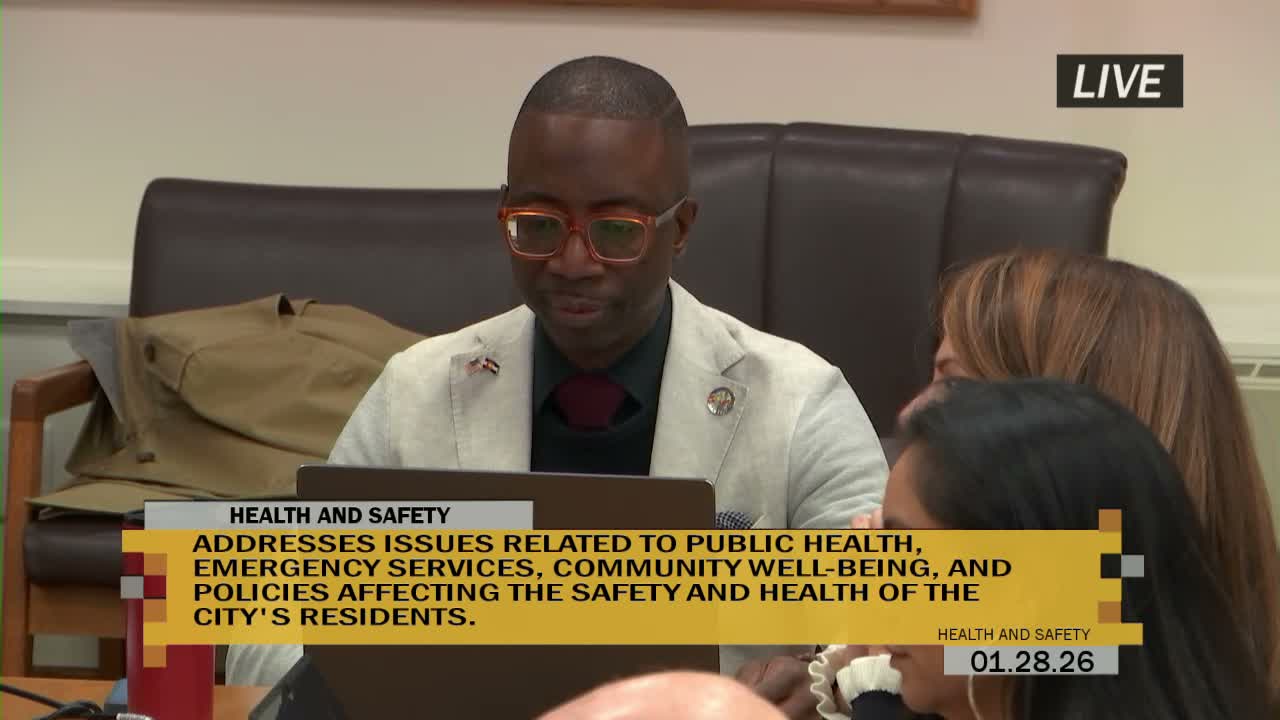
The Denver City Council Health & Safety Committee received an update on Jan. 28 from the Surveillance Technology Task Force on efforts to tighten vendor oversight, data‑retention rules and contract safeguards for surveillance technologies.
Tim Hoffman, director of policy in the mayor’s office, told the committee the task force has focused on creating a baseline inventory of existing policies — including a review of the Denver Police Department operations manual — and completing a vendor risk assessment to identify mitigation options ranging from contract language to potential municipal code changes. "We tried to make sure we had a good cross section of agencies... it thus far has yielded some good productive discussion," Hoffman said.
Tara Segura, a representative from Technology Services, said the city has updated its vendor risk assessment to include privacy, information security, data retention and accessibility questions and has added breach‑and‑remedy language to technology contracts. "We've been able to incorporate those into the assessment," Segura said, adding that the city has inserted a PII certification into contracts tied to the new Motorola 911 system and that the vendor accepted the city's terms.
Council members pressed for more detailed accounting of how third parties have used Denver data. An online council member asked specifically about Flock and automatic license plate reader (ALPR) searches: she requested a shorter, Denver‑focused list of jurisdictions and more detail about subpoenas or exigent disclosures involving Denver data. Hoffman said the mayor’s office will follow up with Flock and work to provide answers.
Council members also urged the task force to move toward ordinance language that would provide durable guardrails. "I'd rather us go into these contracts and enter into these surveillance technology contracts... that we have that setup before we enter into any kind of new contract," Councilmember Sarahna Gonzalez Gutierrez said, urging council review and collaboration.
Several members flagged data‑access and civil‑liberties concerns. Council member Alvidrez asked, "could they subpoena my license plate and know where I'm at, where I'm going," saying the possibility of broad, retained ALPR data is personally worrying. Hoffman said data‑retention, ownership and the circumstances under which the city might be required to disclose data (for example, via subpoena) are a top focus of the task force and that staff will work to provide records about recent subpoenas and compliance.
Hoffman also addressed protections for people accessing reproductive‑health services: the administration has told the task force it would deny out‑of‑state requests for information about people who traveled to Denver for reproductive care. "Under no circumstances would Denver comply with that request for information," Hoffman said, noting the city will consult with advocacy groups and the city attorney’s office as it considers ordinance language.
The task force is surveying other cities (including Seattle, New York City, Madison and Berkeley) that have surveillance ordinances to identify features that might work in Denver, Hoffman said. He added he hoped to have a more concrete proposal for council feedback in the next month or two.
The committee did not take any votes on the surveillance items during the Jan. 28 meeting and adjourned after routine consent items.