Get Full Government Meeting Transcripts, Videos, & Alerts Forever!
Get email alerts on the Budget topic
No spam. Unsubscribe anytime.
Parks & Rec staff review two-year budget; deferred-revenue and staffing needs highlighted
Summary
Parks & Recreation contractor Rochelle told the commission the department uses CivicRec, a credit-card processor and Tyler Munis for finance and that deferred revenue accounting and manual reconciliations mean some revenue shows up in later fiscal years; childcare and instructor staffing remain key constraints and staff expect to finalize a two-year budget.
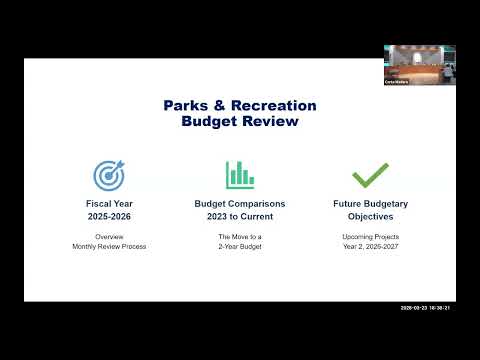
Rochelle, a long-time recreation professional working for the town as a contractor, presented an overview of the Parks & Recreation Department's budget at the March 23 commission meeting and explained why the department moved to a two-year budget cycle.
Rochelle described the department's revenue flow: registrations and facility rentals are taken through CivicRec, credit-card payments are processed by a payment vendor, and the town records transactions in Tyler Munis; staff then perform manual reconciliations to post revenue to the general ledger. "When we moved to the new system a year ago, CivicRec, we decided that we were gonna do deferred revenue," Rochelle said, explaining that fees collected in the spring for programs that begin in the fall are held in a liability account until the program starts.
She said program revenue for FY25-26 is tracking roughly where staff expected: excluding deferred amounts, revenue is currently about 17% below the year-to-date projection but staff are confident they will meet targets with three months left in the fiscal year. Rochelle also noted one example of timing effects: "we brought in $1,000,000 in March, April and May," money that was recorded as deferred revenue until classes and programs began.
Commissioners asked how instructors and coaches are paid. Rochelle said contractor pay is typically based on certifications and tracked by hours; operators of recurring classes often negotiate a revenue split (she cited a typical contractor split of about 60'70% to contractors). The commission also discussed registration glitches in CivicRec and staff's improvements in front-desk support and invoice processing.
Looking ahead, Rochelle said the department plans equipment and facility investments (an upgraded ice machine at the community center, a storage shed for renters and replacement of a nonfunctional accessibility lift) and would like to hire a recreation specialist and an additional mid-level staffer to support childcare programming.
The presentation closed with commissioners thanking Rochelle; no formal budget action was taken at the meeting.