Get Full Government Meeting Transcripts, Videos, & Alerts Forever!
Get email alerts on the Public Safety It topic
No spam. Unsubscribe anytime.
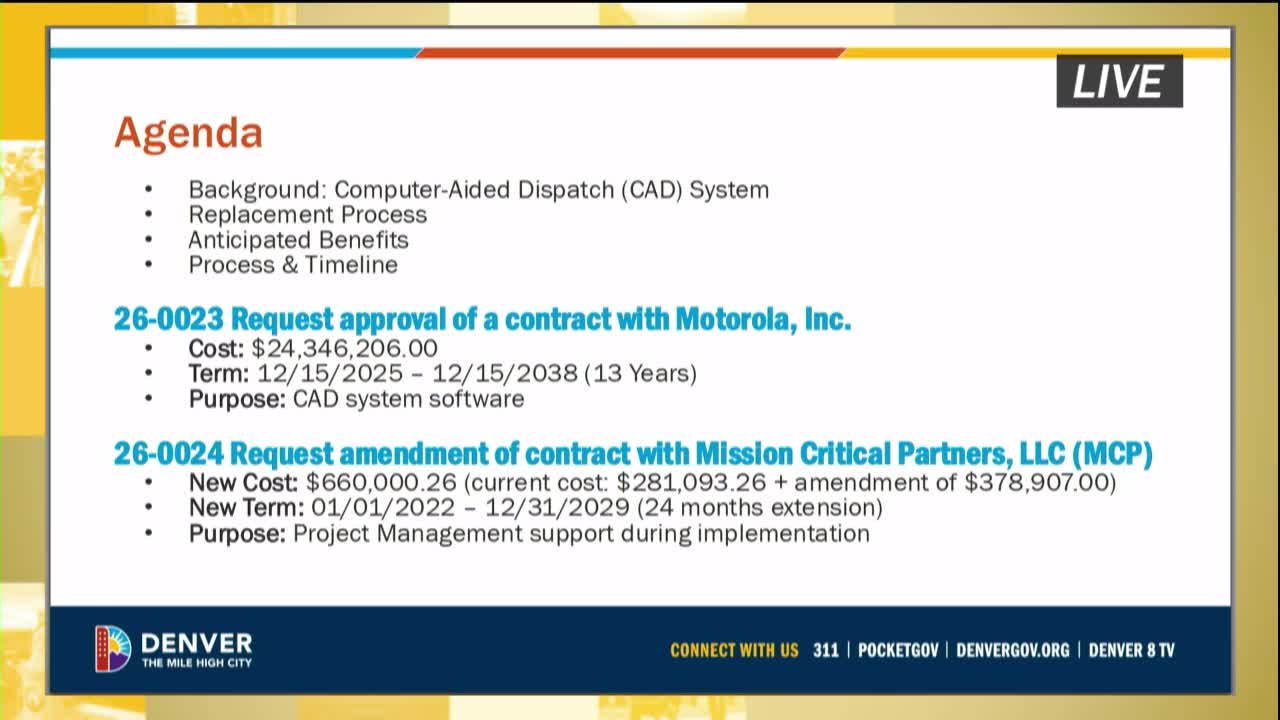
Denver committee advances $24 million Motorola CAD contract and project-management amendment
Summary
The Denver Health & Safety Committee voted to advance a proposed 13-year, just-over-$24 million contract with Motorola to replace the city's computer-aided dispatch (CAD) system and a contract amendment for project-management support; council members pressed the 911 team on resident impact, funding, data protections and contract length.
The Denver Health & Safety Committee on Feb. 4 advanced a proposed 13-year contract with Motorola to replace the city's computer-aided dispatch (CAD) software and an amendment to contract for third-party project-management support.
Darryl Watson, chair of the committee and a Denver City Council member representing District 9, opened the meeting and said the two items would be voted on as a block. Andrew Dammer, director of Denver 911, told the committee the Motorola agreement is for "just over $24,000,000" and would replace a roughly 23-year-old system that the city no longer considers fit for purpose.
"CAD is the primary piece of technology that we utilize at 911," Dammer said, describing the system as the central hub that documents every 911 and non-emergency call and connects more than two dozen public-safety technologies. He said Denver 911 recorded about 1,500,000 unique CAD incidents in 2025 and that the airport created about 60,000 incidents, underscoring the platform's scale.
The city released the CAD request for proposals in March 2024 and selected Motorola in December 2024, Dammer said. The replacement process included evaluations, demos, site visits and assistance from Mission Critical Partners, a consulting firm that would provide project-management services under the proposed amendment; Dammer described a planned 12-to-18-month implementation and a target go-live in summer 2027.
Council members used the Q&A to press the 911 team on how the change would affect residents. "From a resident's perspective, there will be no impact," Dammer said, calling CAD mainly a documentation tool used by call takers and dispatchers. He added that the new platform could open additional non-emergency reporting channels "via text or via a chatbot or via a mobile app" and that the RFP required a robust Salesforce integration to allow handoffs between 311 and 911.
"So there is the potential to have the system tell you, hey, look, while you're waiting on hold, you can text us instead," Dammer said, describing functionality that could reduce non-emergency phone volume. He also said the city's non-emergency 10-digit line accounts for roughly 60% of annual call volume and that integrating app or text reporting could improve capacity for true emergencies.
Council members asked why the proposed contract runs 13 years, longer than the city's typical three-to-five-year standard. Dammer said the extended term reflects the multi-year procurement and implementation effort and a desire to avoid repeating a complex RFP process frequently; he also said the contract includes standard city language and off-ramps should the vendor fail to meet obligations.
The committee also raised data-protection questions. Dammer said Motorola passed Denver's comprehensive vendor risk assessment and cited a provision from the Colorado attorney general that he said "basically eliminates the possibility of federal law enforcement from gaining access" to municipal criminal-justice systems. He noted the city discussed these issues with its chief data security officer during review.
The proposed amendment to the Mission Critical Partners contract would provide project-management support through implementation, Dammer said, and Motorola has offered an optional systems administrator included in cost projections for all 13 years though the city expects that role to be needed primarily in the first three years while internal staff ramp up. Dammer said the annual cost for that administrator increases each year and that he would follow up with a specific figure.
Paul Donaldson, representing Denver International Airport, said continuity of technology and training between airport and city dispatch functions was a key reason the airport supports a unified CAD platform.
After questions, the committee moved the two items (action items 260023 and 260024) as a block. Council member Amanda Sawyer moved the motion and Council member Kevin Flynn seconded; the committee approved the block by thumbs-up and the items will proceed to the full council floor for consideration.
The committee recorded no roll-call vote tally in the transcript; the chair then closed the meeting.