Get Full Government Meeting Transcripts, Videos, & Alerts Forever!
Get email alerts on the Scfd Reauthorization topic
No spam. Unsubscribe anytime.
SCFD outlines five‑phase road to 2028 reauthorization, highlights $3.12 billion regional economic impact
Summary
SCFD executive staff told the Denver City Council Parks, Arts and Culture Committee that the district — which collects one‑tenth of one cent to fund arts, culture and science across seven counties — will begin a five‑phase reauthorization process now to seek a November 2028 ballot measure, citing about $3.12 billion in 2024 economic activity and hundreds of funded organizations.
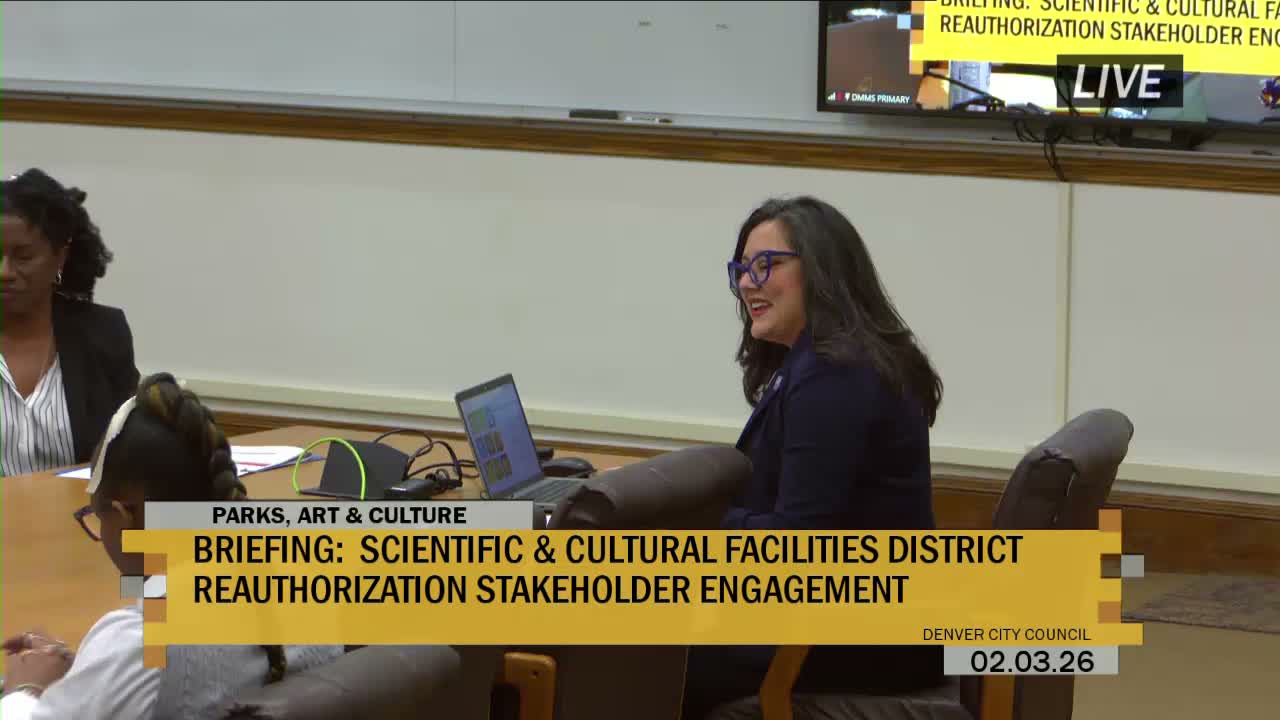
Andrea Albo, executive director of the Scientific and Cultural Facilities District (SCFD), told the Denver City Council's Parks, Arts and Culture Committee that the special district is beginning a five‑phase process that will lead to reauthorization on the November 2028 ballot.
Albo said SCFD, created by state statute, is typically reauthorized about every decade and that the board is ‘‘actively in phase 1’’ — a discovery period that includes data review and stakeholder interviews led by consultant GBSM. ‘‘We reauthorize about every decade,’’ Albo said, adding the statute technically expires in 2030 and the timeline is designed to leave time for implementation if voters approve changes.
Why it matters: SCFD’s allocation formula and reauthorization affect funding for organizations across a seven‑county region and determine how much the tiered funding structure sends to large cultural institutions, midsize organizations and neighborhood groups. Albo told the committee that the district’s formula currently directs 64% of revenue to statutorily listed Tier 1 institutions, with Tier 2 and Tier 3 funds distributed by eligibility processes spelled out in statute.
The presentation cited the district’s scale and economic contribution: a CBCA economic‑impact study cited in SCFD materials shows about $3,120,000,000 in regional economic activity tied to SCFD‑funded institutions. Albo also reported that SCFD funded roughly 304 organizations in 2024 and distributed about $85,000,000 in grants that year (figures presented on slides made available to the committee).
Denver data: Dana Mayotwani, SCFD program officer, summarized county‑level figures: Denver County residents contributed roughly $24,100,000 in SCFD tax revenue in 2024, SCFD partners provided approximately 4,500,000 public engagements with county residents, and 103 Tier 1–3 organizations have primary offices based in Denver County, Mayotwani said.
Programs and equity work: Tatiana Navasnivas, deputy executive director for Denver Arts and Venues, highlighted local program examples supported through SCFD funding, including literary‑arts programming at Lighthouse, Museo de las Americas’ Los Jóvenes Leadership Lab (three cohorts and 43 youth cited by presenters), and the Denver Center for the Performing Arts’ new‑play summit (presenters said it supported roughly 80 readings and distributed about 3,000 tickets). Navasnivas emphasized that the county cultural council review process explicitly centers equity and community representation when recommending Tier 3 funding.
Road to reauthorization: Albo described a five‑phase plan. Phase 1 (current) focuses on data analysis and roughly 25 informational interviews; Phase 2 will be a district‑wide listening tour and public questionnaire; Phase 3 will develop a menu of statutory options; Phase 4 and 5 cover board review, drafting and referral to the legislature and county ballots. Albo noted a separate volunteer campaign organization (referred to in the presentation as CATS) will lead voter outreach and ballot campaign work if the board refers a measure.
Council questions: Committee members asked about ballot logistics, equity, capacity building and funding stability. Councilwoman Paradis asked whether the measure must go on each county’s ballot; Albo confirmed each county must place the measure. Councilmembers pressed SCFD staff on how the district supports smaller organizations that lack fundraising capacity; staff described technical assistance, trainings, discretionary grants for capacity needs, and partnership referrals. Albo cited an example in which a large Tier‑2 organization that lost federal funding partnered with the Denver Museum of Nature & Science to maintain staff and programming while alternative resources were secured.
Next steps and public engagement: SCFD staff said they will conduct the contracted interviews for Phase 1, hold district‑wide listening sessions in Phase 2, and return with proposals for the board’s review. The committee was invited to participate in outreach events including a ‘‘Day at the Capitol’’ event in February; SCFD provided an annual report and the CBCA study in committee materials for members to review.
The meeting record: Committee chair Flora Lidres closed the discussion and noted a consent item before adjourning the meeting without a recorded vote on reauthorization.
Sources and attributions: Quotes and figures in this article are drawn from presentations and answers delivered to the Parks, Arts and Culture Committee by Andrea Albo (Executive Director, SCFD), Dana Mayotwani (SCFD Program Officer) and Tatiana Navasnivas (Deputy Executive Director, Denver Arts and Venues).