Get Full Government Meeting Transcripts, Videos, & Alerts Forever!
Get email alerts on the Zoning Initiative Rezoning topic
No spam. Unsubscribe anytime.
Proponents outline plan to rezone Denver near transit and parks for more affordable, sustainable housing
Summary
At a Jan. 22 review-and-comment hearing, proponents of a citizen-initiated ordinance said the measure would upzone parcels near transit lines and large parks to allow more affordable and walkable housing; city attorneys pressed them on legal limits, definitions, and implementation details and asked the proponents to resubmit revised language.
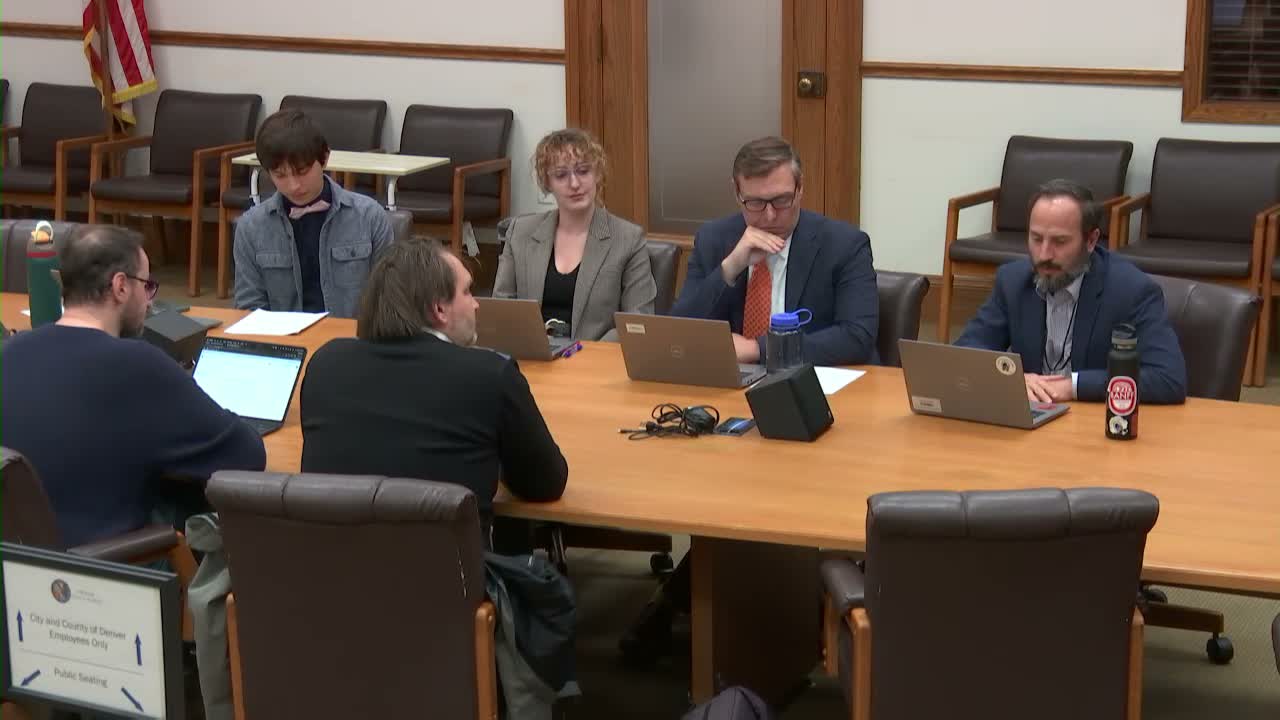
Luke Palmisano, senior legislative policy analyst for the Denver City Council, opened a Jan. 22 review-and-comment hearing on a citizen-initiated ordinance that would rezone parcels within walking distance of transit lines and major parks to permit more affordable and sustainable housing forms.
"We are here for the review and comment hearing for a proposed initiated ordinance rezoning permitting more affordable and sustainable housing forms within walking distance of existing, transit lines and large parks," Palmisano said at the start of the session.
The proponent, David Pardo, told staff the initiative aims to "ensure that Denver zoning allows for more housing near transit stations, transit routes, and major parks" and said the campaign seeks placement on the Nov. 2026 general-election ballot if statutory requirements are met. "We would like to have it on the ballot in November, 2026," Pardo said.
City legislative counsel and assistant city attorneys conducted a line-by-line review and raised legal and implementation questions. Jonathan Griffin, deputy legislative counsel, and Brooks Fordham, an attorney fellow with legislative council, asked whether the measure treats zoning as a legislative action, how it would interact with the Denver zoning code and chapter 59, and how the city would implement rezonings if the initiative passes.
Pardo said the measure is intended as a legislative rezoning that would ultimately sit in the Denver zoning code (DCC) rather than remain a chapter 59 patch. He told staff the drafters expect to "harmonize" the initiative with existing processes and, where notice and public hearing are otherwise required, to follow applicable procedures. On legal risk, Pardo said he believes existing case law supports treating zoning as legislative and that the proposal could be adjusted to accommodate any adverse higher-court rulings.
Staff flagged several undefined or ambiguous terms in the text. Counsel asked the proponent to clarify the ballot title process; Brooks Fordham noted ballot-title approval rests with the clerk and recorder. Staff also asked the drafters to define or clarify terms such as "affordable residential," "BRT centerline," and the reference to Denver Moves Transit. Pardo said the team would either incorporate existing city definitions or replace cross-references with clearer language — for example, defining community parks by acreage (he noted there are 10 regional parks and 41 community parks in Denver data) or anchoring transit references to a specific version or date of Denver Moves Transit.
On technical triggers for rezoning, the drafters proposed distance-based boundaries (for example, 660 feet in the draft); counsel asked why that number was chosen. Pardo explained that 660 feet is roughly an eighth of a mile (about 200 meters) and said the team would consider using quarter-mile or other more legible distances if staff recommended that change.
Staff also pressed the proponents on how the measure would interact with existing affordability rules. Counsel asked whether mandatory-affordability rules in Article 10 of Chapter 27 would apply in the proposed districts and how the initiative would treat mixed-use or commercial development. Pardo said the drafters intend to follow existing city definitions and that some issues — such as whether the mandatory-affordability threshold applies to sub‑10‑unit buildings — could be harmonized with Denver’s ongoing Unlocking Housing Choices and Expanded Housing Affordability work.
Legal questions included whether the initiative addresses legislative rather than administrative matters (counsel cited Steve Orra v. Zwerdlinger) and whether pending state litigation (Kavanaugh v. Telluride Locals Coalition) could affect the measure. Pardo said the measure was written to be generalized and that, if necessary, the drafters could adapt the language to remain compatible with court developments.
The proponent agreed to carve out sensitive categories and city-owned or operation-critical properties. "I definitely want to exempt DIA and any open space A or C," Pardo said when staff asked how airport-area parcels might be affected. Staff also suggested stadium districts and other special categories might need explicit exclusion language.
On enforcement and exemptions, staff asked what "cost neutrality" means in the draft and who would determine whether a rezoning is impossible or uneconomic. Pardo described a pragmatic view — roughly assessing lifecycle costs over a multi‑year horizon — and said the drafters would consider delegating granular determinations to a zoning administrator or rulemaking process. He acknowledged the need to refine language on administrative authority and appeal paths.
After the line-by-line review, counselors suggested resubmission with clarified definitions and any suggested cross-reference edits. Griffin said the office will send a certificate of compliance and a proposed ballot title; if the proponents resubmit, the city then has 10 business days to decide whether a second hearing is required.
The council closed the formal portion of the hearing and thanked the proponent team for the rapid responses and willingness to work with staff. The proponents agreed to refine the draft and to consult further with CPD (the planning agency) and legislative counsel before resubmitting.
Next procedural steps: the proponent will receive the certificate of compliance and proposed ballot title; resubmittal will restart the city's review clock (10 business days to determine whether another hearing is required). No formal motions or votes occurred at this session.