Get Full Government Meeting Transcripts, Videos, & Alerts Forever!
Get email alerts on the Municipal Prosecution topic
No spam. Unsubscribe anytime.
City attorney's PACE section reports rising municipal caseloads, domestic-violence surge and expanded victim services
Summary
The city attorney's PACE section told the Health and Safety Committee that municipal case filings rose to more than 14,300 last year and that domestic-violence filings climbed to roughly 2,529 in 2025; PACE described victim advocacy, diversion programs and nuisance-abatement tools.
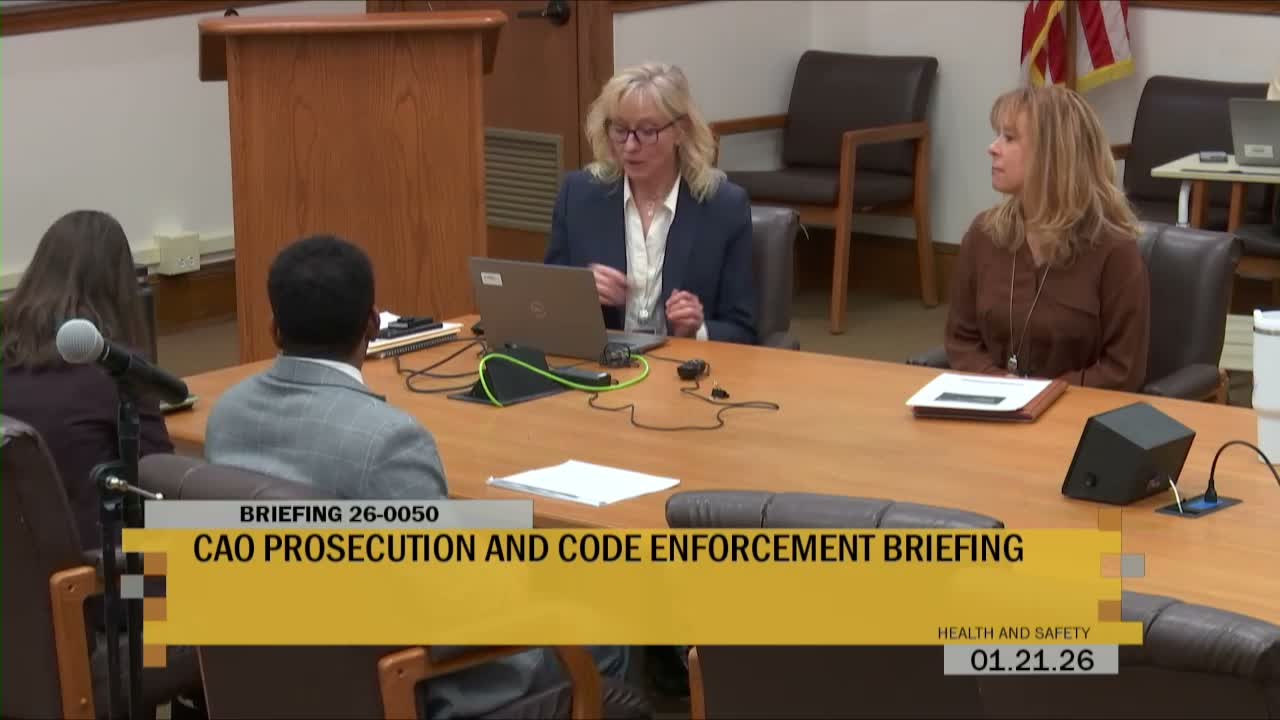
Marley Bardoski, director of the prosecution section (PACE) in the Denver City Attorney's Office, briefed the City Council Health and Safety Committee on Jan. 21 about rising municipal caseloads, victim services and diversion efforts.
Bardoski told the committee that PACE handled "over 14,300 cases" last year and that filings have increased annually since 2022. On domestic violence, the office's victim-advocacy manager, Linda Laughlin Pettit, said the office handled 2,529 domestic-violence cases in 2025, a year-over-year increase that the office characterized as a 19% rise from 2024.
PACE described a courtroom and service structure that includes four trial courtrooms, two arraignment courtrooms (one operating seven days a week in the downtown detention center), a juvenile courtroom staffed on rotation, and a mental-health team that handles involuntary commitments and extreme-risk-protection orders. The office also staffs a victim-advocacy team that provides bilingual and bicultural services, rapid outreach to victims before arraignment and coordinated safety planning.
On juvenile cases, PACE said diversion is being used as a primary tool: diversion was described as being offered in about 90% of juvenile matters, with aims to keep youth out of the state criminal justice system when appropriate. An assistant director told council members that many juvenile cases now flow directly to diversion programs rather than into citation or court dockets.
Bardoski also explained civil nuisance abatement as an enforcement tool for conduct such as street racing, where the office can pursue civil remedies against vehicles when individual drivers cannot be identified. She cited prior use of nuisance abatement to take vehicles out of circulation in a high-profile event and said the remedy can deter repeat conduct.
Councilmembers raised data and privacy concerns. Councilmember Paradis said slides showing victims' injuries caused discomfort for some members and asked whether case numbers attached to the slides could be removed to reduce the risk of identifying victims; PACE said it would consult legal counsel and reconsider slide content. Bardoski also acknowledged that the office does not currently track housing status for prosecuted individuals and agreed to follow up on data availability after the meeting.
The briefing concluded with questions about methamphetamine contamination abatement and interagency coordination; PACE said it works with Denver Public Health & Environment and other agencies on testing, abatement and housing alternatives when residences are placarded.
What's next: Council members asked PACE to provide follow-up data on case demographics and on options for removing case numbers or images from public slide decks if they risk identifying victims.