Get Full Government Meeting Transcripts, Videos, & Alerts Forever!
Get email alerts on the Street Safety Alameda topic
No spam. Unsubscribe anytime.
Denver committee hears DOTI’s revised Alameda designs and plans for months‑long street demonstrations
Summary
DOTI staff told the Transportation and Infrastructure Committee they recommend a "partial" lane repurposing for Alameda Avenue and will run multi‑month on‑street demonstrations to measure diversion, congestion and safety after community petitions and new crash analysis prompted a recheck of earlier plans.
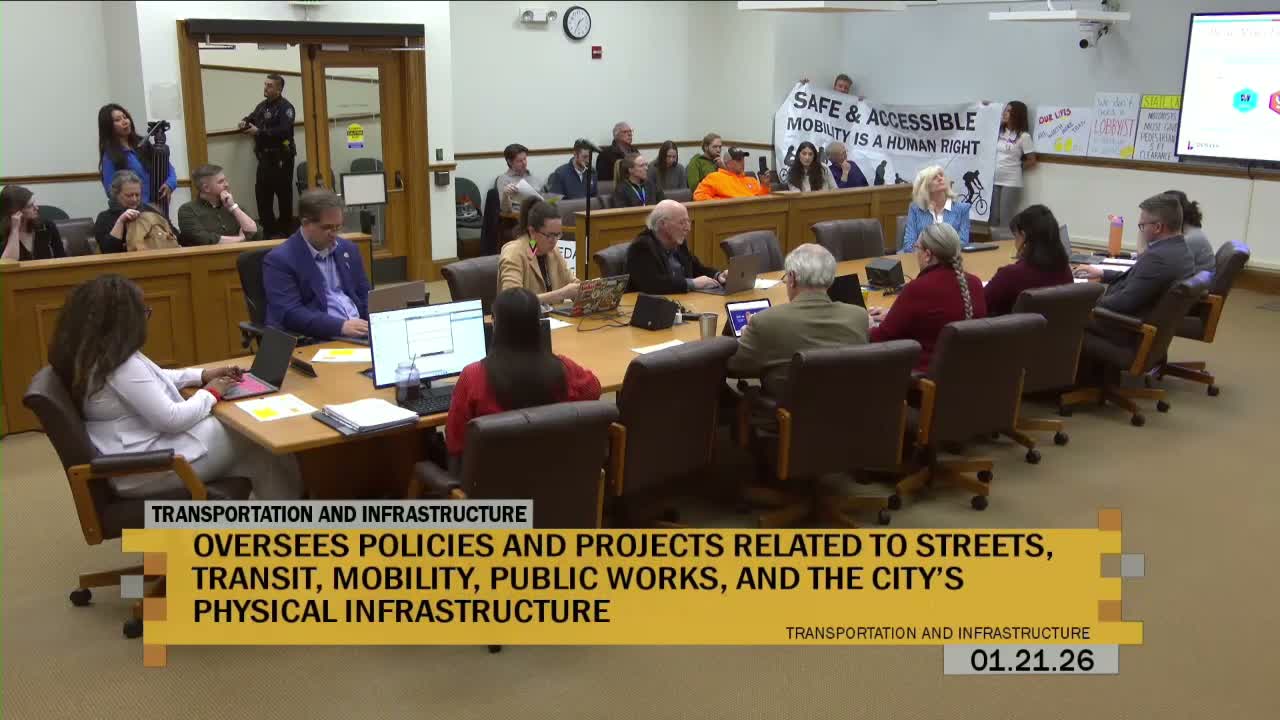
At a biweekly meeting of the Transportation and Infrastructure Committee of the Denver City Council, Department of Transportation & Infrastructure (DOTI) staff presented a revised plan for Alameda Avenue and proposed several months of on‑street demonstration deployments to test traffic diversion and safety outcomes.
The department described two alternatives: the original full lane repurposing (one travel lane each direction with center turn pockets) and a partial repurposing that keeps two eastbound lanes and one westbound lane while maintaining key pedestrian safety elements. "The partial lane repurposing has 2 lanes in the eastbound direction...and then 1 lane going westbound," Molly, a DOTI presenter, said while describing the current recommendation.
DOTI officials told council members the partial design was recommended after staff re‑examined crash data and diversion risk. Staff said Alameda’s mainline crash history is largely vehicular (rear‑end and sideswipe), while nearby Virginia Avenue — which borders Wash Park — shows more pedestrian and cyclist involvement. Amy, a DOTI analyst, said the reanalysis flagged the possibility that a full repurposing could divert traffic onto Virginia and other side streets, potentially increasing risk there.
Why it matters: Council members repeatedly framed the decision against the city’s Vision Zero goals and urged clarity about whose safety is being prioritized. Several council members pressed staff for hard comparative metrics answering questions such as: if modeled diversion increases by 5% or 10% onto Virginia, what is the expected change in injury risk? Councilwoman Alvidrez said outreach was "broken" and argued the department should show the full repurposing in a demonstration so the council and public can see potential benefits firsthand.
What DOTI proposed: Staff outlined a two‑part next step. First, DOTI plans temporary, demonstrative on‑street deployments that would remain in place for several months so engineers can collect real‑world data on diversion, congestion, crash rates and pedestrian comfort. "We'd like to do a temporary demonstration deployments here over the next several months where we will then work and analyze and validate the data that we see," Amy said. Second, DOTI intends to proceed with some permanent safety installations that were part of prior designs (examples cited included flashing beacons at Franklin and protected left‑turn treatments at Virginia/Downing), even as the demonstration runs.
Key numbers and context reported by staff during the meeting: DOTI said Virginia had about 58 crashes over a four‑year period with a small number of nonfatal injury crashes, and that detailed pedestrian/cyclist crash counts on Virginia were low but nonzero (staff referenced four pedestrian/cyclist crashes in the reviewed timeframe). Staff also said average daily traffic volumes on Alameda have fallen since 2011–12, from just over 20,000 then to roughly 15,000–17,000 now — a change DOTI cited as part of the rationale for reconsidering lane configuration.
Points of contention: Multiple council members questioned the timing and transparency of DOTI’s analysis. Councilwoman Paradis cited an email she read from a DOTI project lead saying leadership had "decided to move forward with a partial lane reduction," and asked why that direction predated the additional safety work. Amy and Molly said staff began internal analysis in July–August, continued through mid‑October, and that further modeling and community engagement informed the final recommendation. Councilman Cashman and others argued stakeholders had previously crafted and supported a full lane repurposing and that reversing that recommendation risks eroding trust.
Next steps: Committee members asked DOTI to return with requested crash data, comparative analyses (including the 2011–12 experience cited by several council members), and a detailed plan for the demonstration deployments. Staff offered a tentative date to report back and present high‑level demonstration plans and early metrics (February 18 was proposed as an available date during the meeting). No formal votes or motions on the design were taken at the meeting; the committee adjourned after placing five consent items on the agenda.
The committee’s decision timeline remains open: DOTI will run demonstrations, collect and analyze results, and present findings to the committee before any final configuration is adopted.