Get Full Government Meeting Transcripts, Videos, & Alerts Forever!
Get email alerts on the Peer Review Special Education topic
No spam. Unsubscribe anytime.
State subgroup weighs formal peer-review system to identify best practices in special education
Summary
State education officials and district leaders discussed creating a formal peer-review cycle for special education programs to surface and share best practices; most participants urged improving dissemination of existing supports (regional meetings, emails, coach networks) rather than imposing new administrative burdens.
A state education agency official outlined plans to develop a peer-review process for special education programs that would identify best practices, set a rubric and create a cycle for review and dissemination, prompting a subgroup discussion about whether to formalize reviews or expand existing regional supports.
Why it matters: Lawmakers charged the subgroup with studying item C2 from recent legislation, which calls for peer review of special education programs. The group’s conversation focused on how to define "best practice," measure outcomes and get promising practices to school staff without imposing extra administrative work on districts.
Brian, a presenter from the state education agency, told the subgroup the proposal would align with the state board of education’s strategic plan and the agency’s general supervision role. "The creation of a peer review process for special education programs," he said, should include "what that cycle looks like and the process for identifying those programs and establishing the needs to be gathered around that process" and then how findings would be disseminated.
The moderator — who led the meeting — urged the subgroup to adopt an explicit rubric modeled on federal peer-review practices, saying the U.S. Department of Education assembles panels of expert peers and uses detailed rubrics to review evidence for state assessments. "So we'd have to define what is a best practice...and then establish a cycle and identify peers who's gonna do this work and then figure out what we need to gather and then the dissemination," the moderator said.
Presenters described several existing activities that could feed into a peer-review system, including newly developed secondary transition standards, an approved-private special education approval process and pilots tied to a now-ended federal state personnel development grant. On measuring impact, the agency uses a post‑secondary outcome survey that checks whether students are employed, in higher education or engaged in community activities one year after graduation.
District leaders who spoke favored strengthening current dissemination channels rather than creating new, mandatory reporting. "The regional meetings that directors have is very powerful," said Amy, a special-education director who participates in regional convenings. She described weekly emails from the state, statewide webinars, and communities of practice as the most effective ways for districts to share strategies. "Maybe a process set in place where we talk to other districts on a more formal basis? Maybe. But it's going to be very, very difficult to get every director in the state available at a specific time," she added.
Ann Marie Cullinan, who identified herself as a coach for the Connecticut Association of Schools and a former special-education director, recommended using coaches as an additional vehicle to distribute resources and mentor new administrators. "I coach seven new administrators in special education in the state, and I'd love to have this information to bring out to them," she said.
Concerns about administrative burden surfaced repeatedly. Several members warned that requiring every district to submit and present a best practice could become onerous and that membership-based venues cannot compel participation. One committee member suggested the subgroup first "calibrate" what it means to move the needle — a step the group agreed would be useful before designing mandatory processes.
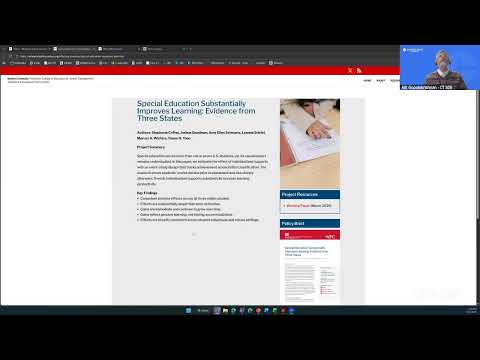
The moderator closed by noting a recent Boston University Wheelock Policy Center report, which the moderator said found that special education identification was linked to improved student trajectories in Connecticut, Indiana and Massachusetts; the subgroup planned to circulate the study link. Next steps: subgroup leads said they would reconvene to synthesize findings and determine whether the final recommendation will propose a formal peer-review cycle or emphasize better use of existing dissemination systems.