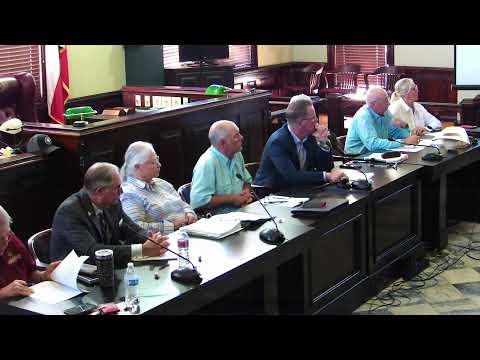
Erath‑Somerville planning commission adopts stricter transmission‑siting policy, finds project application incomplete
Loading...
Summary
The Erath‑Somerville Subregional Planning Commission on March 24 adopted an updated Chapter 391 transmission‑siting policy requiring applicants to identify aviation facilities and historic groundwater wells; the commission also said the current 765 kV certificate application lacks sufficient information to assess environmental and safety impacts.
The Erath‑Somerville Subregional Planning Commission adopted an updated Chapter 391 transmission‑siting policy on March 24 that requires developers to identify and evaluate aviation facilities and historic groundwater wells before routes are approved.
The commission also issued a formal finding that the certificate application currently before regulators for the proposed 765‑kilovolt transmission route “does not contain sufficient information to fully evaluate the impacts” on groundwater resources, undocumented wells, cemeteries, agricultural operations, public‑safety communications and aviation facilities, the chair read during the meeting.
Why it matters: commissioners and members of the public said the proposed route could intersect private airstrips used for agricultural operations and areas with historic, undocumented wells that may pose contamination or access risks if transmission infrastructure is constructed. The policy directs that any proposed transmission project within the ESSRPC jurisdiction must identify and map wells (including those not reflected in digital records) and demonstrate that construction, operation and maintenance will not render wells inaccessible or create pathways for groundwater contamination.
“Once transmission infrastructure is constructed, the ability to identify and properly plug, abandon, or [remediate] previously unknown wells within the right‑of‑way may be severely compromised,” the chair said while reading language derived from a groundwater district letter. The commission incorporated language from the Middle Trinity Groundwater Conservation District (cited in the meeting) raising concerns under Chapter 36 of the Texas Water Code about omitted historic wells.
The policy also adds aviation‑safety requirements, saying routes must identify private airstrips, agricultural aviation operations and helipads and demonstrate that proposed structures will not create hazards to takeoffs, landings or low‑altitude agricultural flight operations.
The policy text was edited in the meeting to explicitly include Somerville and surrounding counties in the policy’s scope. Commissioners said they will continue to refine the language and incorporate additional input from state and federal agencies.
Action and votes: the commission approved the updated policy by voice vote after a motion from Commissioner (speaker 2) and a second; no opposition was recorded in the meeting minutes. Earlier on the agenda the commission also approved the prior meeting’s minutes, accepted the City of Stephenville’s resolution to join the ESSRPC and seated the city’s two delegates, Mayor Lon Reisman and Councilman Gerald Cook.
Public response and next steps: speakers from the public and community advocacy groups urged residents to file testimony with the Public Utility Commission record and offered to help commissioners and residents prepare questions for coordination meetings with state wildlife and conservation agencies. One participant noted that the commission had received thousands of filings on the project: “There’s been 3,684 filings on our line,” the chair said, urging continued, coordinated public engagement.
Eric Duff, who identified himself to the commission, told the meeting that drone flights and on‑site equipment do not mean construction is imminent: “Nobody needs to worry that Encore is just gonna show up and start working it on anything,” he said, and urged people to file comments and attend a Saturday information meeting in Lingleville.
Commission staff said demand letters requesting meetings were sent to Texas Parks and Wildlife and the U.S. Fish and Wildlife Service, and to the project developer, Encore; commissioners said they will wait for responses and prepare follow‑up letters or calls if agencies do not reply.
Timing: commissioners said the route is to be selected or denied by Aug. 18, 2026, hearings are scheduled for a week in May in Austin, and the commission discussed meeting through the testimony phase with possible additional call meetings in late March and early April. The chair told residents the deadline for testimony had been extended to April 8 (the transcript includes some discussion about April 8 vs. April 9 timing). The commission adjourned at 2:40 p.m.
What the meeting did not resolve: the commission did not reject or approve any specific route; it adopted a policy setting procedural and substantive expectations and concluded the current application record is incomplete for impact determination. Further review and coordination with state and federal agencies were directed.
Votes at a glance: the commission approved (1) the March 17 minutes; (2) the City of Stephenville’s resolution to join the ESSRPC; (3) the seating of Mayor Lon Reisman and Councilman Gerald Cook as delegates; and (4) the updated Chapter 391 transmission‑siting policy with edits. All actions were adopted by voice vote with no opposing votes announced in the meeting transcript.