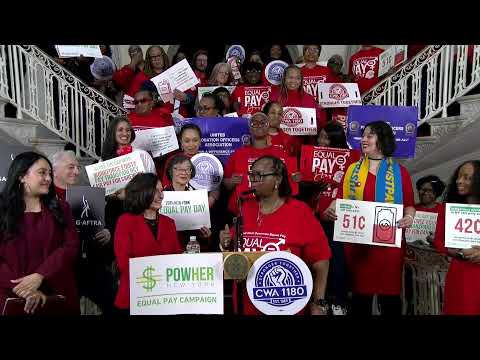
City Hall rally marks 20th Equal Pay Day; Speaker Julie Manning revives paid-disparity report
Loading...
Summary
Organizers, union leaders and elected officials gathered at City Hall for the 20th annual Equal Pay Day rally to urge immediate action on wage gaps; City Council Speaker Julie Manning announced the revival of the council's paid-disparity report and Attorney General Letitia James and labor leaders highlighted legal and data-based tools to close pay gaps.
At a 20th annual Equal Pay Day rally inside New York City Hall, organizers and elected officials urged renewed action to close gender and racial wage gaps and pushed for data-driven accountability from city agencies.
Bev Neufeld, president of Power New York and co-chair of the New York Equal Pay Campaign, opened the event and highlighted recent local figures: "It's 91¢ to the dollar here in New York," she said, adding that the figure falls to 81¢ when part-time workers are counted and that the average woman can lose roughly $10,000 a year because of the wage gap. "That is totally unacceptable," Neufeld said, calling for urgency on pay transparency and better pay for care workers.
Gloria Middleton, president of Communications Workers of America Local 1180, introduced New York State Attorney General Letitia James, saying labor and community groups have been "fighters for equal pay" and that the movement has produced local reform. Robin Blabat, secretary-treasurer of CWA Local 1180, reviewed the union's multi-year investigation into City Hall pay disparities, its federal EEOC action and a 2019 settlement: "We didn't stop. We organized," Blabat said, noting that the union's work helped prompt Local Law 18, which requires city agencies to report on pay by gender, race and ethnicity.
Attorney General Letitia James framed pay inequity as a long-term economic loss. "Each year, I hope, is our last," James said, calling Equal Pay Day a reminder of how long into the year women must work to equal men's prior-year pay. She quantified the stakes in lifetime terms, saying a woman can lose roughly $400,000 over a 40-year career and that losses are substantially higher for many women of color.
Council member Amanda Farias, chair of the Committee on Women and Gender Equity, emphasized pay-transparency measures and recent council work on private-sector reporting. "You cannot say you support women and families while ignoring the policies and investments that actually make things just," Farias said, urging legal and budgetary changes to protect workers.
Speaker Julie Manning announced the revival of the City Council's paid-disparity report, which Manning said had been delayed under the previous administration. "We're gonna make sure that, once and for all, we get the data because it is the data that shows these disparities," Manning said, pledging council follow-through in partnership with the administration.
Speakers also tied pay equity to the broader care economy. Shanita Bowen of the Empire State Campaign for Childcare and ECE on the Move urged investment in family childcare and higher wages for educators, saying universal childcare is "not just about care. It's about pay equity." Sahair Khwaja of Legal Momentum stressed that pay disparity is "a form of wage theft" that undermines affordability and the stability of households.
Organizers used the event to press officials for sustained action: continuing Local Law 18 reporting, stronger private‑sector disclosure requirements and investments in the caregiving workforce. After remarks, participants posed for photographs and organizers said they would take questions from the press.
The council's announced revival of its paid-disparity report establishes the next concrete step: officials said staff will work to obtain agency data and resume reporting on pay differences across city agencies. Organizers said they will continue monitoring the report's progress and press for both city and state-level measures to reduce the wage gap.