Eversource asks PURA to securitize $1.42 billion in storm costs, seeks retroactive carrying charges
Loading...
Summary
Eversource (Connecticut Light & Power) told the Public Utilities Regulatory Authority it wants to securitize about $1.42 billion in 2018–2023 catastrophic storm costs and asked PURA to recognize carrying charges (financing costs) back to the date costs were incurred; commissioners pressed for alternate calculations (debt-only, prime-rate) and late-filed worksheets.
Eversource Energy asked the Public Utilities Regulatory Authority (PURA) during evidentiary hearings to authorize securitization of roughly $1.42 billion in prudently incurred storm costs from 2018 through 2023, and to recognize carrying charges on those deferred balances.
The company said securitization — issuing long-term bonds through a special-purpose vehicle — would lower financing costs for customers and immediately restore the company's liquidity, while the company seeks recognition of carrying charges it says it incurred while financing those storm expenses.
Why it matters: securitization changes who bears financing costs and when: if PURA authorizes securitization the company argued it would pass debt costs to the special-purpose entity and lose any corporate-level recognition of carrying charges unless the commission explicitly allows them now. The company told PURA it proposed securitizing the full 2018–2023 balance (including its calculated carrying-cost component) because the financing tool minimizes customer bill impacts compared with traditional rate recovery.
What the record shows: during cross-examination Steve Capozzi (authority staff) focused on Exhibit ESSFP-6, which the company used to calculate carrying charges. Company witnesses described the number in column I as the company's authorized weighted average cost of capital (WACC) grossed up for income taxes. The panel agreed to provide underlying WACC inputs and tax gross‑ups in a late-filed exhibit (late file 31) and to break out carrying‑charge components (WACC, debt-only, prime-rate proxy) so commissioners can compare alternatives.
On the amount: the company presented customer contributions recorded through June 2027 (including projected reserve accruals) of about $335 million and said additional actions (including a $100 million replenishment recently authorized in the draft RAM decision) would reduce but not eliminate the balance. The company estimated a projected non‑securitized balance through 06/01/2027 of about $472 million (inclusive of 2024–25 storms and forecasted 2026–27 activity), and argued securitizing the 2018–2023 tranche offers the lowest bill impact to customers.
Accounting and legal context: witnesses and counsel reviewed PURA's August 2023 decision in docket 22‑0808 that changed how deferrals were treated by taking certain storm regulatory assets out of rate base and treating them as deferred expenses. Company witnesses said that order eliminated the prior "compensatory" effect of placing deferred storm costs in rate base (which had, in practice, provided some offsetting return) and that the combination of that decision, a state law authorizing securitization, and a court decision (Aquarion) altered the landscape and motivated the current filing.
Areas of contention and next steps: commissioners repeatedly asked for alternative carrying-charge calculations (weighted average cost of debt; a prime‑rate proxy used in Massachusetts; and the company's WACC-based calculation) and for reconciliations tied to accrual dates versus cash-payment dates; the panel agreed to deliver those as late-filed exhibits (late files 31–33). PURA has not ruled; the hearing record will include the late-filed data and a future decision will need to explain the chosen benchmark and whether any retroactive recognition of carrying charges is allowed. The hearing schedule continues with additional operational panels and further cross-examination on April 1.
Representative quotes: "Securitization is a game changer for our customers," said Doug Horton, the company's senior vice president of regulatory and strategic financial planning, urging PURA to authorize the mechanism to achieve the lowest financing cost for customers. "Most of my questions today are about carrying charges," said Steve Capozzi, authority staff, who pressed the panel on the inputs behind ESSFP‑6.
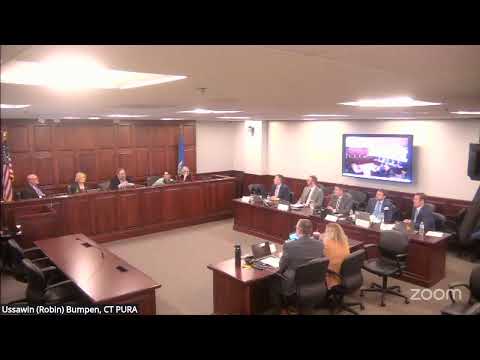
The procedural status: the company's revenue‑requirements/securitization witness panel adopted prefiled testimony and was cross-examined by authority staff; parties requested and the panel agreed to produce additional late-filed calculations to aid PURA's decision-making. The commission set further hearings and will consider those late files before issuing a final order.