Get Full Government Meeting Transcripts, Videos, & Alerts Forever!
Get email alerts on the Student Support topic
No spam. Unsubscribe anytime.
Brandon Valley Middle School details "Starfish" initiative to connect students with a trusted adult
Summary
Principal Amanda Nelson and staff described the "Starfish" initiative: an in-service outreach and student survey found 93 of 800 students initially had no identified adult relationship, staff engagement reduced that number to eight, and a Feb. 10 student survey showed near-universal participation. The program aims for every student to name a "go-to" adult by year-end.
Principal Amanda Nelson and Brandon Valley Middle School staff presented the "Starfish" initiative to the Brandon Valley School Board, describing a staff-led effort to make sure every student has at least one trusted adult in the building.
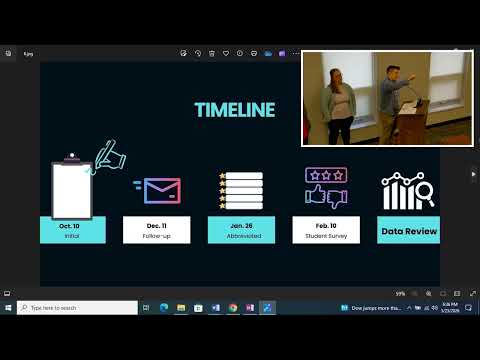
Nelson told the board the program began on an in-service day when staff posted the names of all 800 students and asked adults to initial names of students with whom they had a relationship. "There were 93 students out of 800 that there were no teachers identified having a relationship with that student," the assistant principal said, and staff were challenged to adopt at least one of those students. "We reduced it down . . . to 8 kids," the assistant principal added, describing the drop from 93 to eight after staff engagement.
The presenters said a student survey launched on Feb. 10 produced very high participation: "The first day it was sent out, we had 89% completion rate," a presenter said, and when final data were pulled only a single student had not completed the survey. The survey asked whether students had a "go-to adult," whether teachers cared about them as people, and whether students knew who to go to for help; presenters reported roughly nine in 10 students answered positively to those items.
Teacher Jamie Button and Assistant Principal Hoffman emphasized that the adults students named included not only classroom teachers but custodial staff, lunchroom employees and other support staff. "There's only 9 adults that weren't listed out of 79," a presenter said when describing staff identified as go-to adults, noting the importance of visible, approachable adults across job classifications.
Presenters summarized practical next steps: prioritize predictability (for example, scheduled times and locations where a student can reliably find an adult), focus staff attention on micro-moments (brief check-ins and name use in hallways), and target remaining students who do not yet feel connected. They set a goal that by the end of the school year 100% of students will be able to name a go-to adult.
Board members praised the initiative and asked about program evaluation, including staff surveys and academic outcomes. One board member encouraged expanding or pairing the program with support in other buildings; a teacher on the panel said she had taken on a student who previously had no adult identified and had already seen improvement in the relationship.
The board did not take formal action on the presentation; presenters said they will continue data collection and implementation steps into the fourth quarter.