Public safety chiefs tell Boston council they are staffing and planning for a large summer of events
Loading...
Summary
Boston emergency responders told a City Council committee they have scaled staffing, mutual-aid agreements and intelligence-sharing plans for overlapping 2026 events, while councilors pressed for clarity on costs, private security oversight and interagency information-sharing.
Chair Henry Santana convened the Boston City Council Committee on Public Safety and Criminal Justice on March 26 to review city preparations for multiple large events in 2026, including FIFA matches, Tall Ships and the citys 250th anniversary. Councilors sought details on staffing, cost-sharing and how the city will protect both residents and visitors.
The hearings lead sponsor, Councilor John Fitzgerald, said the goal was to reassure families that public-safety agencies are prepared. "We're not giving away the answers to the test here," Fitzgerald added, while thanking police, fire and EMS for planning work. That theme framed most exchanges: officials described broad strategies but withheld operational specifics for security reasons.
James Hooley, chief of Boston EMS, told the committee Boston EMS fields about 440 EMTs and paramedics who responded to roughly 141,000 clinical incidents in 2025 and transported more than 95,500 patients. He said the department has a special-operations division that covered nearly 1,000 events last year and that planners treat large special events like planned mass-casualty incidents, emphasizing surge staffing, regional hospital distribution and language-access capabilities. "Chance favors the prepared mind," Hooley said, urging continued investments in training, equipment and interoperable planning.
Deputy Superintendent Sean Martin of the Boston Police Department described an intelligence-driven approach led by the Boston Regional Intelligence Center (BRIC), MOUs and mutual-aid agreements with neighboring cities and state and federal partners, and operational planning that includes crowd-management and traffic-flow strategies. Martin said the BRIC and the state Fusion Center exchange information daily. He added that supplemental staffing will be requested from partners on an event-by-event basis to avoid reducing normal neighborhood patrols.
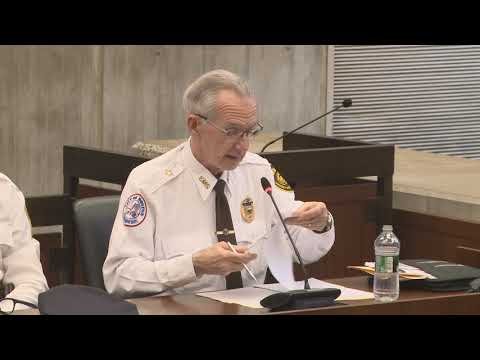
Commissioner Paul Burke of the Boston Fire Department said the department has 1,552 members with about 264 on duty at any time and will rely on overtime and mutual aid as needed. Burke emphasized unified command structures for events and said hazmat units are positioned across the city for neighborhood coverage. "We have the plan ready and staffed," he said, noting the citys planning posture has been strengthened since 2013.
Councilors pressed agencies on several recurring concerns. Councilor Liu Yijian and others asked whether federal grants and other funding would cover overtime and other municipal costs; officials said grants are being pursued but that some costs will likely remain borne by the city and that they do not yet have a finalized cost matrix. Councilor Clara Zapata asked what officers should expect for overtime and whether the city would contract private security or new surveillance technologies. Martin said vacation blocks would be honored but discretionary days may be restricted during peak periods; BPD is not contracting private security centrally, though event hosts are often required or encouraged to hire private security tied to permit conditions. On surveillance, Martin and Commissioner Burke confirmed that drones are deployed in coordination with fire for event monitoring.
On intelligence sharing, Councilor Culpepper recommended an MOU that would ensure information flow between the state Fusion Center and BRIC for Boston-specific intelligence; Martin said the two entities already work and exchange information daily but deferred procedural details to BRIC. Multiple councilors urged clearer, multilingual public messaging about dates and traffic impacts; officials said targeted communications are planned and will be pushed out through media-relations channels and community service officers.
Officials also outlined operational examples: EMS said it could add roughly 85 personnel and multiple ambulances for a marathon-scale event, plus bicycle and foot teams, aid stations and smaller rapid-response units to treat and, when safe, return patients to the crowd without hospital transport. Fire and EMS noted plans to provide water, cooling stations and MBTA air-conditioned buses if a heat incident requires sheltering.
The hearing did not include any motions or votes. Chair Santana read a letter from Adrian Jordan, chief of the Office of Emergency Management, highlighting OEMs coordinating role and a new emergency operations center at 12 Channel Street that will support multiagency incident command. The committee ended without public testimony and was adjourned.
The council requested follow-up details on costs and private-security vetting and encouraged agencies to continue providing the public with event-specific, multilingual notices. The committee indicated it will stay engaged as event dates solidify and grant applications develop.