
Professor tells Senate Vermont remains in drought; wells and farms at risk
Get AI-powered insights, summaries, and transcripts
Sign Up Free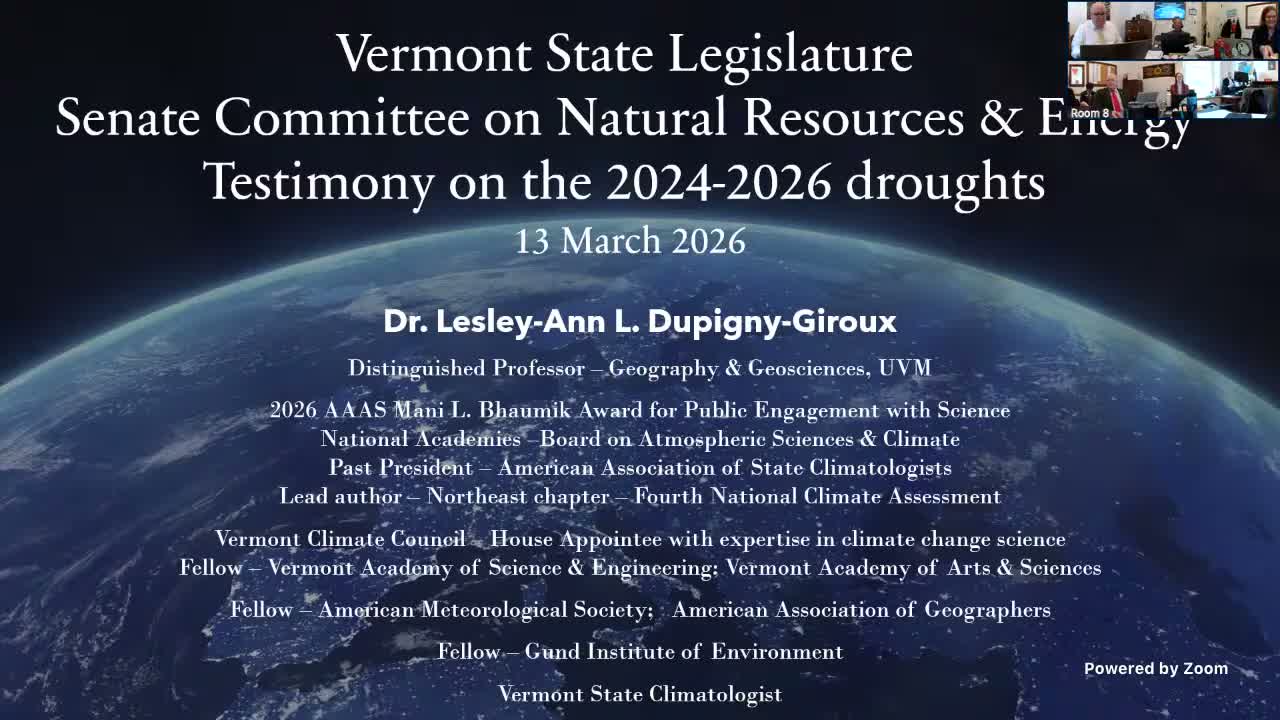
Summary
At a March 20 Senate Natural Resources & Energy hearing, a visiting professor and climatologist told the committee Vermont's 2025 drought set historic lows for groundwater, produced a rapid "flash drought," and left wells, farms and lakes at heightened risk; the witness urged improved local reporting and a multi-agency drought plan.
On March 20, at the Senate Natural Resources & Energy committee hearing, a visiting professor and climatologist told lawmakers Vermont remains in drought conditions and urged the state to strengthen monitoring and reporting systems.
The professor, introduced to the committee at the start of the session, said measurements from US Geological Survey wells showed many sites hit their lowest depths on record in late 2024 and that parts of the state continued to set new lows into 2025. "We are still in a drought right now," the professor told the committee, adding that the 2025 event included a fast-developing "flash drought" that accelerated in August and caused rapid soil-moisture loss.
Why it matters: committee members sought to understand near-term risks to drinking-water wells, agriculture and the lake system. The witness highlighted three linked risks: shallow groundwater and dry wells, crop and hay losses for livestock, and warmer lake temperatures that increase the chance of harmful algal blooms.
Details from the testimony included these technical points: the presenter showed US Drought Monitor maps and a long-term drought index that uses records back to 1895; he said that while Vermont does not experience the same drought profile as some western states, this episode reached historic extremes locally. The witness also described observed impacts in late 2024 and 2025—dry wells, ponds and boat launches inaccessible, increased algae in sections of Lake Champlain—and pointed to a red-flag wildfire day in October as evidence of elevated fire risk.
The professor recommended specific, actionable steps: build a public dashboard (noting a Cornell collaboration in progress), expand community reporting tools (story maps and uploads of local observations), integrate well-reports with state and federal datasets, and consider statutory or trigger-based approaches used elsewhere. "If we don't know where things are drying out, we draw incorrect lines, and we don't get USDA triggered," the witness said, urging better local reporting so federal relief lines can be set accurately.
Committee members asked about data access following recent federal cuts; the professor said core datasets and methods remain publicly available and that state-federal partnerships (National Weather Service, USGS) continue to provide operational support. The witness offered to share model language and examples from other states' notably a South Carolina well-response framework' and to provide technical assistance for a Vermont drought-response plan.
What happens next: committee members requested the link to the materials the witness used and discussed circulating sample legislation and triggers for consideration. The committee chair said she would pursue follow-up and welcomed the witness's offer of additional data and assistance.