Get Full Government Meeting Transcripts, Videos, & Alerts Forever!
Get email alerts on the Municipal Budget topic
No spam. Unsubscribe anytime.
Finance director presents balanced tentative FY26 budget, warns of lease-revenue reliance
Summary
Boulder City staff presented a tentative FY26 budget balanced on lease revenues and fund balance, projecting a multi-year gap until additional solar and battery lease income begins in 2029; staff recommended tapping fund balance in the near term while asking council to revisit reserve ceilings and fund rules.
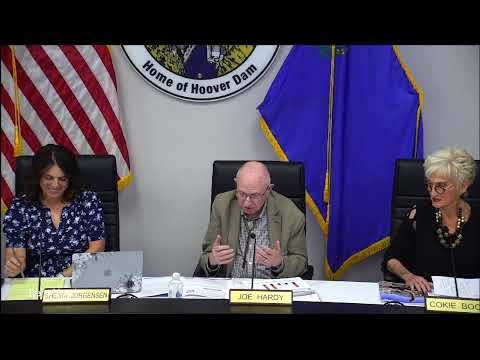
Finance Director Cynthia Snead and Budget Manager Angela Manninen presented a tentative fiscal year 2026 budget that staff described as balanced but structurally reliant on lease revenues and prior-year savings.
"I'm Cynthia Snead, your finance director, and… pleased to to bring forward the tentative budget, which is a a balanced budget," Snead said, warning council that lease revenue makes up roughly 35% of the general fund and that rising retirement contributions and labor costs are increasing pressure on operating expenses. Manninen told the council staff projects general fund revenues of $46,100,000 and budgeted expenses of $46,800,000, with the roughly $600,000 gap to be offset by prior-year fund balance.
Manninen said two new contracts — identified in the presentation as Boulder Flats ($1,200,000) and Boulder Solar ($900,000) — add about $2,100,000 in recurring rents and royalties. Total lease revenue across funds is projected at about $23,200,000; staff said 70% of lease receipts ($16,300,000) flow to the general fund and 20% ($4,600,000) to the voter-approved capital improvement fund.
Staff projected the city will need to draw on fund balance over the next few years because expenses are expected to outpace revenues until additional lease revenue from solar and battery projects becomes fully commercial, currently forecast around 2029. Snead noted legal constraints on debt (no issuance above $1,000,000 without voter approval), limiting one common municipal financing option for capital projects.
On reserves, staff estimated an expected general fund balance of roughly $25,000,000 at the end of FY26 and reiterated the council's ordinance that the operating reserve should remain between about 8.33% and 16.66% of expenditures (approximately $3.6M–$7.3M under current forecasts).
The tentative budget will be submitted to the Nevada Department of Taxation; staff said the council can schedule additional hearings April 22 or May 13 before a final adoption planned for the May 27 council meeting.