Get Full Government Meeting Transcripts, Videos, & Alerts Forever!
Get email alerts on the Water Supply topic
No spam. Unsubscribe anytime.
Sequim public works director says city has sufficient water for roughly 30 years; outlines long‑range plans
Summary
Paul Busich told the Sequim City Council that after reviewing water rights, production and pipelines the city can meet demand for about 30 years while pursuing a coordinated “all‑things‑water” initiative, continued aquifer monitoring and targeted capital projects.
Paul Busich, Sequim’s public works director, told the City Council that the city’s groundwater supply and existing system should meet expected development and population growth for roughly the next 30 years while staff pursues a coordinated long‑range water strategy.
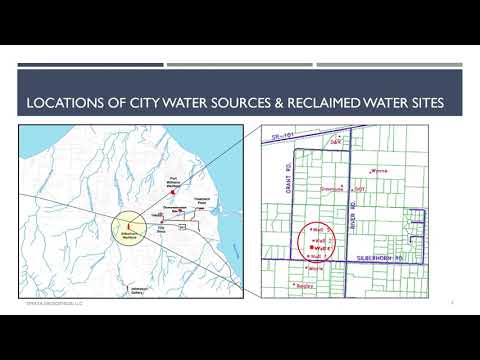
"We have sufficient water resources to handle development for the next 30 plus years," Busich said, summing up the presentation. He and staff reviewed system assets — three well sites (Silverhorn Well Field, Port Williams Well Field and the Rainy Collector Well), four booster stations, nine pressure‑reducing valve stations, three reservoirs totaling about 3,000,000 gallons, roughly 77 miles of mains, more than 2,000 valves and over 600 hydrants — and the city’s metering and monitoring program.
Busich told the council that the city’s certificated water rights total about 1,850 acre‑feet per year after a closer review with the State Department of Ecology and that the 2022 Water System Plan had previously overstated available certificated rights. "The 2022 system plan had identified a number of water rights that, after looking in them in greater detail and discussing with Ecology, we've agreed that was overestimating how much certificated water rights the city has," he said. He added that Port Williams’ entitlement was intended as a supplement and is duplicative rather than additive to the other rights.
Staff reported recent operating and demand figures: average daily production over the last three years is about 1,100,000 gallons per day (roughly 393 million gallons per year), and population estimates used in staff modeling rose from about 6,900 to 8,400 (2023–2025). Using a revised population growth assumption of about 1.5% annually (down from an earlier 3% forecast), the city’s evaluation shows it will reach roughly 75% of certificated water‑right utilization by mid‑century under current assumptions; one staff estimate projected reaching 80% around 2052–2053, while a planning baseline flagged 2045 as a planning horizon for increased capacity needs.
Busich also cited system efficiency and monitoring results: Sequim’s unaccounted water is about 8% (below the 10% national norm), and the city has deployed approximately 3,100 automated meters to help detect leaks and track usage. He noted a modest rise in per‑equivalent‑residential‑unit daily use (from 149 to 155 gallons) in recent years and said staff will investigate causes.
On long‑range needs, Busich said the 2022 plan identified projects including a new deep well, an additional reservoir, a booster station near Reservoir Road and a new pressure zone around 620 feet elevation to serve areas now on the PUD system. Those improvements would increase capacity and firefighting flows and help serve up to about 3,100 additional ERUs in affected zones.
Busich introduced a citywide strategic initiative he called an "all‑things‑water" approach to align potable water, wastewater, stormwater and reclaimed water planning. He noted the city already uses reclaimed water for irrigation at Cary Blake Park, a demonstration site and the city shop and said expanding reclaimed‑water uses could reduce pressure on potable supplies. He cautioned that reclaimed water is not suitable for human consumption and is tightly regulated.
Acknowledging climate uncertainty, Busich said there are no definitive answers about how climate change will affect Sequim’s groundwater but listed plausible risks: diminished river flows that could indirectly reduce supply to the Rainy Collector Well, changes in timing of recharge from reduced snowpack, and the potential need to curtail production if recharge declines. He said the city is monitoring aquifer levels and will rely on geohydrologists’ analyses.
On funding, Busich outlined revenue sources — utility rates, meter installation fees, general facilities charges, loans and grants — and reiterated the principle that "development pays for development," noting utility extension agreements and developer‑funded design and construction as standard tools to make new development bear the cost of necessary infrastructure.
Busich closed by urging confidence in the city’s permitting and review processes and said staff will continue monitoring water rights, aquifer behavior and permit activity while advancing the strategic initiative. He offered to remain in the audience to answer council questions.
The council had not taken formal action during the presentation; Busich’s remarks were a staff briefing and an update on planning and monitoring.