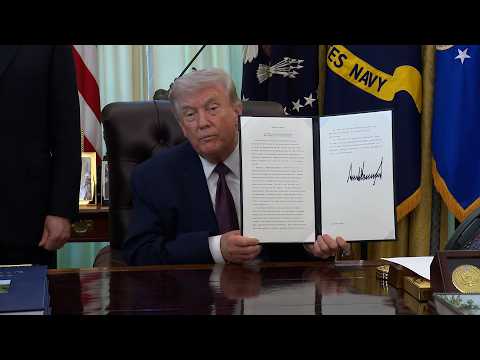
President unveils executive order to tighten verification of mail-in ballots
Loading...
Summary
The President announced an executive order directing federal data sharing with states and ordering the U.S. Postal Service to verify that mail ballots are sent to and returned by eligible voters; an attorney at the event described plans for USPS barcodes on ballot envelopes and one-envelope-per-vote tracking.
The President announced an executive order aimed at strengthening the security of mail-in voting, saying the measures would give state election officials a more complete view of eligible voters and ordering the U.S. Postal Service to verify ballots both when they are sent and when they are returned.
"We're going to take federal data. We're going to ensure that each state's election officials are provided with a comprehensive view of who the eligible voters in their jurisdiction actually are," said Will Scharf, an attorney introduced by the President, describing the executive order's core data-sharing provision. Scharf also said the order directs the Postmaster General and the U.S. Postal Service to take "bold new measures" to verify that ballots are addressed to eligible voters and returned by eligible voters.
Howard Lutnick, brought forward by the President to explain operational details, said the plan includes a USPS-generated barcode on ballot envelopes and a move to "one envelope per vote" so election officials can track and distinguish mailed ballots. "If you voted by mail, you will have it on the envelope," Lutnick said, specifying the tracking cue would appear on the envelope rather than on the ballot itself.
The President linked the executive order to broader goals he said included voter identification and proof-of-citizenship requirements, describing those proposals as subjects for later action. He framed the order as a response to what he called widespread problems with mail-in ballots: "The cheating on mail in voting is legendary," he said, adding that the measures were "foolproof" in his view.
Why it matters: The order would change how federal and postal data are used in support of state-run elections and would create new verification steps for mailed ballots. Scharf's description — particularly the barcode and envelope-tracking proposal — suggests operational changes that would require coordination between the Postal Service and state election officials. The President acknowledged possible legal challenges to the order.
What the record shows and what it does not: The transcript records the President's announcement and attorneys' descriptions of the order's aims, including federal data-sharing and USPS verification steps. The transcript does not include the executive order's full text, implementation timelines, nor confirmation that state election officials have agreed to the described procedures. It also does not record a formal signature ceremony in the transcript text, though the President announced his intention to sign the order at the event.
Next steps: The President said he planned to sign the order at the event and anticipated legal challenges, noting judges could block the measure and that he expected appeals if necessary. The President and his speakers did not provide a detailed implementation schedule, and the transcript includes no statements from state election officials or the Postal Service accepting or describing how they would implement the proposed barcode and verification processes.