Consultants preview voluntary island‑wide retreat and relocation program; virtual public open houses set for April 16
Loading...
Summary
SCAPE and Arcadis presented a draft voluntary retreat and relocation program to the Coastal Resilience Advisory Committee, describing maps, 'sending' and 'receiving' areas, TDR‑style incentives and outreach plans; committee members pressed for clarity on triggers, receiving‑site availability and financing.
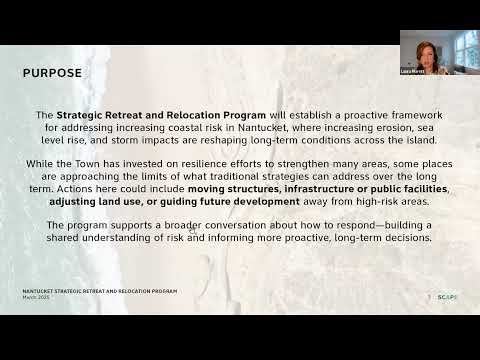
SCAPE and Arcadis on Tuesday previewed a draft island‑wide strategic retreat and relocation program intended to help Nantucket plan for sea‑level rise, erosion and storm impacts. Laura Morette, a principal at landscape‑planning firm SCAPE, told the Coastal Resilience Advisory Committee the program is voluntary and designed to be "a framework to identify potential receiving areas, a way to understand risk and future scenarios." The consultants said they will use maps, triggers and a toolkit of incentives — including TDR‑style mechanisms — to encourage relocation from high‑risk areas to safer receiving sites.
The program is explicitly framed as proactive and equity‑focused, the consultants said. Devin McKay of engineering firm Arcadis walked members through hazard maps showing tidal‑flood and storm‑surge exposure concentrated downtown and in low‑lying shore neighborhoods. McKay said the team’s modeling suggests that, by the end of the century, roughly "1,500 structures" could be exposed to coastal storm surge flooding — a figure the consultants said helps guide where incentives and alternatives might be most necessary.
Committee members pushed for clearer public messaging, defined regulatory steps and realistic options for land and financing. Joanna Roach urged the team to add a slide that explains which local boards and permits—zoning, planning and the Conservation Commission—would need to be involved. Doug Rose and others urged the consultants to assemble a broad toolkit of incentives (conservation easement swaps, gifts, bargain sales and others) and warned that Nantucket’s limited undeveloped land and extensive conservation holdings will constrain receiving‑site options.
Several members also asked the consultants to engage local building‑moving companies and produce ballpark cost estimates for moving structures and associated permitting. "If a private property owner’s thinking about moving a structure, the building‑movement companies understand how to navigate permitting and logistics," Morette said, and SCAPE said it plans to meet with movers to capture that information and reflect it in later outreach materials.
Outreach plans include two virtual open‑house sessions on Thursday, April 16 (9:30 a.m. and 5:30 p.m.) with Mentimeter polling and facilitated breakout rooms; SCAPE and town staff plan additional in‑person public workshops in the summer. Leah Hill, Natural Resources staff, said outreach will combine local advertising, email blasts, flyers and a Spanish‑language Zoom room to broaden participation.
Next steps: the consultants will refine the public presentation, develop summer strategies for retreat and relocation and return to the committee with maps, refined trigger proposals and a draft roadmap for implementation later in 2026. The committee recommended the presentation include clearer regulatory guidance, local case studies and cost information to help residents assess "what's in it for me."