DOT official says Alaska Trails program needs stable funding as requests top $3.1 million
Loading...
Summary
Rebecca Garrett of DOT&PF told the House Transportation Committee that Alaska Trails and Local Access Systems (ATLAS) — encompassing multiuse trails, ice roads, winter trail marking and snow-trail grooming — faces persistent demand that outstrips available funds, and asked legislators for predictable support to expand access in rural communities.
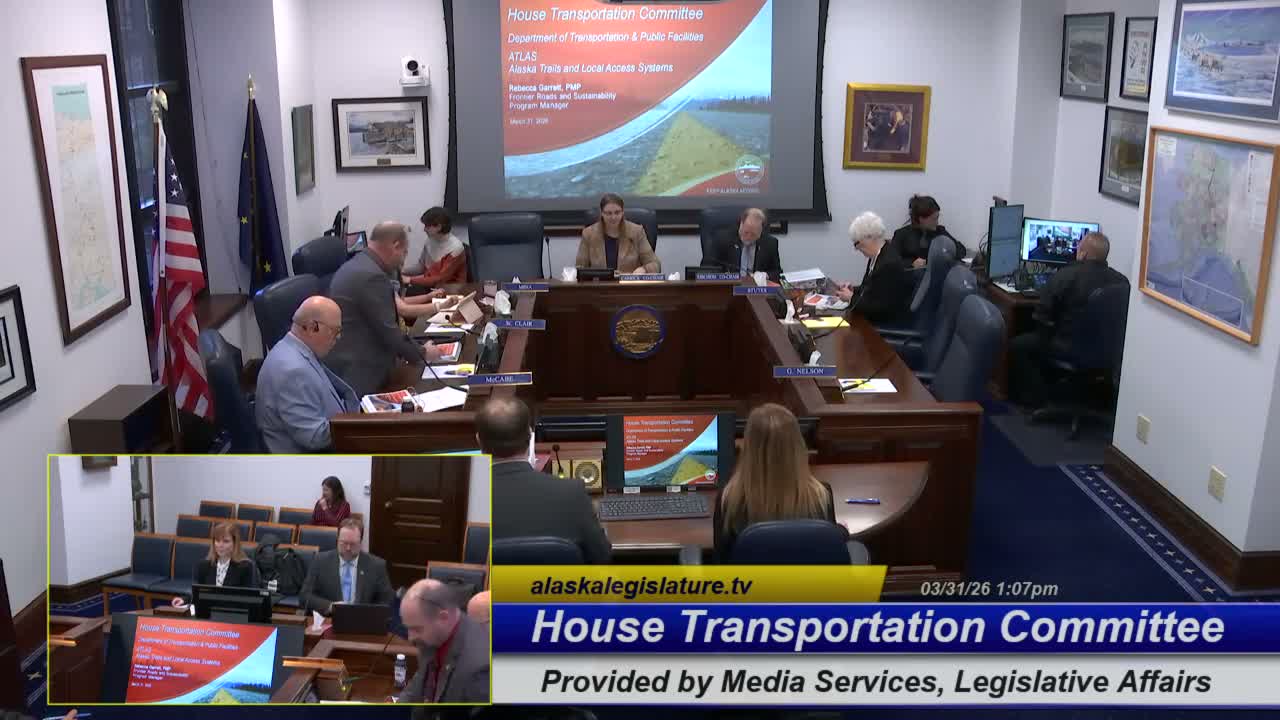
Rebecca Garrett, Frontier Roads and Sustainability Program Manager for the Alaska Department of Transportation and Public Facilities, told the House Transportation Committee on March 31 that Alaska Trails and Local Access Systems (ATLAS) is a statewide approach that treats trails and seasonal routes as transportation infrastructure in rural Alaska.
"Atlas is a statewide transportation system focused on trails and seasonal infrastructure," Garrett said, explaining that in many communities traditional roads are not feasible and trails, ice roads and groomed routes provide essential connections for health care, education, subsistence and search-and-rescue. She said the program is delivered through partnerships with tribes, local governments and nonprofits.
Garrett described the four core components of ATLAS: multiuse trails (the Recreational Trails Program, RTP), safe ice roads, winter trail marking and snow-machine trail grooming. She told the committee that RTP was transferred to DOT from the Department of Natural Resources by Administrative Order 361 to better integrate trails with statewide transportation planning.
"Recent applications requested over $3,000,000 in funding," Garrett said. On snow-trails specifically she told the committee, "we receive about $90,000 a year in registration fees. The application total for this year for snow trails was $3,100,000. We had $1,800,000 available." She added that some expected federal funds arrived late (March 27), but demand still far exceeded available dollars.
Committee members pressed DOT officials about how funding is allocated and who decides priorities. Andy Mills, DOT special assistant and legislative liaison, explained that the RTP federal guidance establishes a 30/30/40 distribution among motorized, non-motorized and diversified uses and that the newly formed Alaska Recreational Trails Advisory Committee (RTAC) is charged with reviewing project criteria and helping ensure parity.
Representative Rosanna McCabe raised concerns from motorized-user groups that non-motorized projects have been prioritized in some local cases; Mills said DOT took over RTP administration in part to address those past concerns and that the agency has been working with DNR and local stakeholders as projects transition.
Garrett also reviewed ATLAS’s seasonal programs. She said DOT anticipates roughly 750 miles of ice road this season awarded to villages and local entities rather than built directly by DOT, and that the agency has about $2.5 million in awards supporting ice-road projects. She described equipment and local capacity as recurring constraints for communities building and maintaining those routes.
On winter safety programs, Garrett said high-visibility markers and route signage help navigation and search-and-rescue work but that outreach and formal education programs are limited. For the snow-trails grooming program she estimated roughly 1,650 miles groomed annually and reiterated that registration fees plus existing federal and state support do not cover demand.
Garrett summarized common barriers across ATLAS: demand outstripping funding, federal match requirements that can be difficult for small communities, limited local equipment and capacity, and the need for more administrative resources to manage growth. She recommended legislative action to provide stable funding, reduce match barriers for rural communities, invest in local equipment and capacity, and integrate ATLAS programs into statewide transportation planning.
The committee did not take formal action on funding or policy at the meeting. Co-chair Kerrick noted a planned field demonstration this Thursday (weather permitting) and adjourned the committee at 2:13 p.m.