Senate committee hears testimony on SB 281 to join four interstate health licensure compacts
Loading...
Summary
The Senate Health and Social Services Committee held an initial hearing on SB 281 on March 31 to authorize Alaska’s participation in four interstate licensure compacts (physicians, physician assistants, psychologists/PSYPACT, and EMS). Supporters said compacts streamline licensing and aid rural access; members pressed questions on data, fees and cultural competency.
The Senate Health and Social Services Committee held an initial hearing March 31 in Butchrovich Room 205 on SB 281, a bill that would authorize Alaska to join four interstate professional licensure compacts intended to streamline licensure and improve workforce mobility for physicians, physician assistants, psychologists (PSYPACT) and emergency medical services personnel.
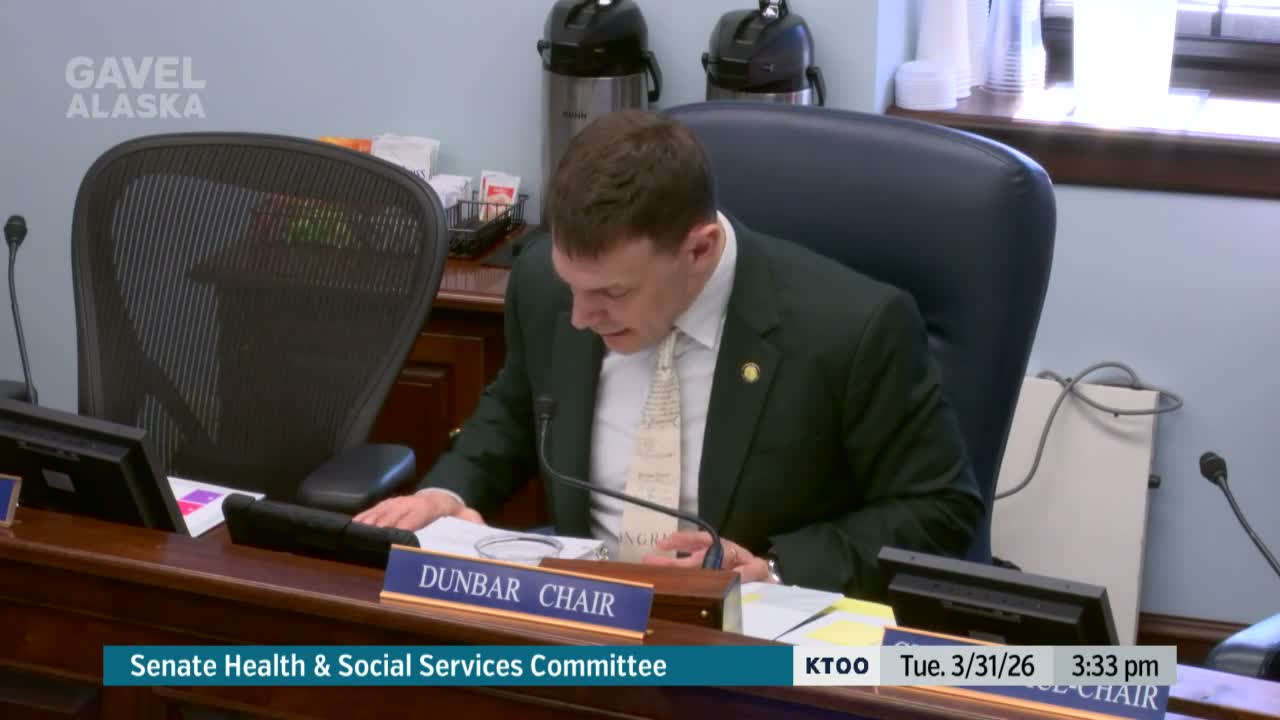
Ariel Harbison, staff to chair Senator Dunbar, told the committee the measure was included in the state’s rural health transformation planning and said joining compacts could “improve health care access, enhance workforce mobility, and reduce administrative barriers while preserving state regulatory authority.” The sponsor’s office signaled a committee substitute is likely and that some PA scope-of-practice language would be removed before final consideration.
Carl Sims of the Council of State Governments, who gave an overview of how compacts work, described two common licensure models and data systems. “Simply, it’s a legislatively enacted agreement between two or more states,” Sims said, adding compacts may use either a multistate license or a privilege‑to‑practice model and that commission-run data systems vary by profession.
Physicians and PAs: The IMLC and PA compact Megan Hall, a practicing PA in Anchorage and past president of the Alaska Academy of Physician Assistants, urged support for the PA compact, saying it creates an efficient “compact privilege” pathway that reduces delays and administrative burdens and preserves state scope-of-practice rules. “In a state as geographically isolated as Alaska, any added delay caused by licensing barriers only makes access challenges worse,” Hall said.
Pam Venchen, executive director of the Alaska State Medical Association, said the association previously worried compacts might encourage fly‑in, fly‑out practice that risks continuity of care but now supports the Interstate Medical Licensure Compact because employers commonly pay multistate fees and the compact expedites licensing. “It makes it much easier for physicians to apply for a license in Alaska,” Venchen said, while noting the compact does not change the state medical board’s authority to investigate complaints and discipline licensees.
Psychology: PSYPACT Committee staff summarized provisions for PSYPACT, which covers telepsychology and temporary in‑person practice (up to 30 days per year) and requires authorization via an e‑passport or interjurisdictional practice certificate plus fingerprint-based background checks. Marvo Rigendon of the Alaska Psychological Association said a membership survey and board vote led the association to endorse PSYPACT, while flagging concerns about accreditation pathways for graduates of some Alaska programs and the need to ensure out‑of‑state practitioners understand Alaska’s cultural and geographic context.
Janet Orwig, executive director of PSYPACT, emphasized that authorization holders must acknowledge and follow the receiving state’s scope-of-practice and public‑health rules and that disciplinary action in any member state will revoke PSYPACT privileges across members.
EMS personnel compact The EMS compact presented by committee staff would allow EMTs, AEMTs and paramedics with an unrestricted home‑state license and affiliation with an Alaska EMS agency or medical director to provide care in Alaska under a privilege‑to‑practice model. Donnie Woodyard of the Interstate Commission for EMS Personnel Practice told the committee Alaska can keep unique local EMS clinician levels and that the compact adds a coordinated, real‑time database for licensure and adverse actions. “There is no fee to the state. There’s no fee to the individuals,” Woodyard said, emphasizing benefits for disaster and wildland response.
Questions and concerns Committee members pressed witnesses on how receiving states learn when a compact practitioner is practicing in‑state, who pays verification and licensing costs (witnesses described a mix of applicant fees and existing state licensing fees), and whether telehealth or compact privileges could affect local clinicians’ practices. Witnesses said data systems and notification mechanisms vary by compact and that, for privilege models, the receiving state is notified when a practitioner applies for a privilege in that state.
What’s next Chair Senator Dunbar closed the hearing, noting the committee expects a committee substitute and plans to take up SB 281 again; the committee’s next meeting is April 7. No formal action or vote on SB 281 occurred at this session.