DNR permitting office says it can handle surge in large projects; carbon‑offset program has not yet generated revenue
Loading...
Summary
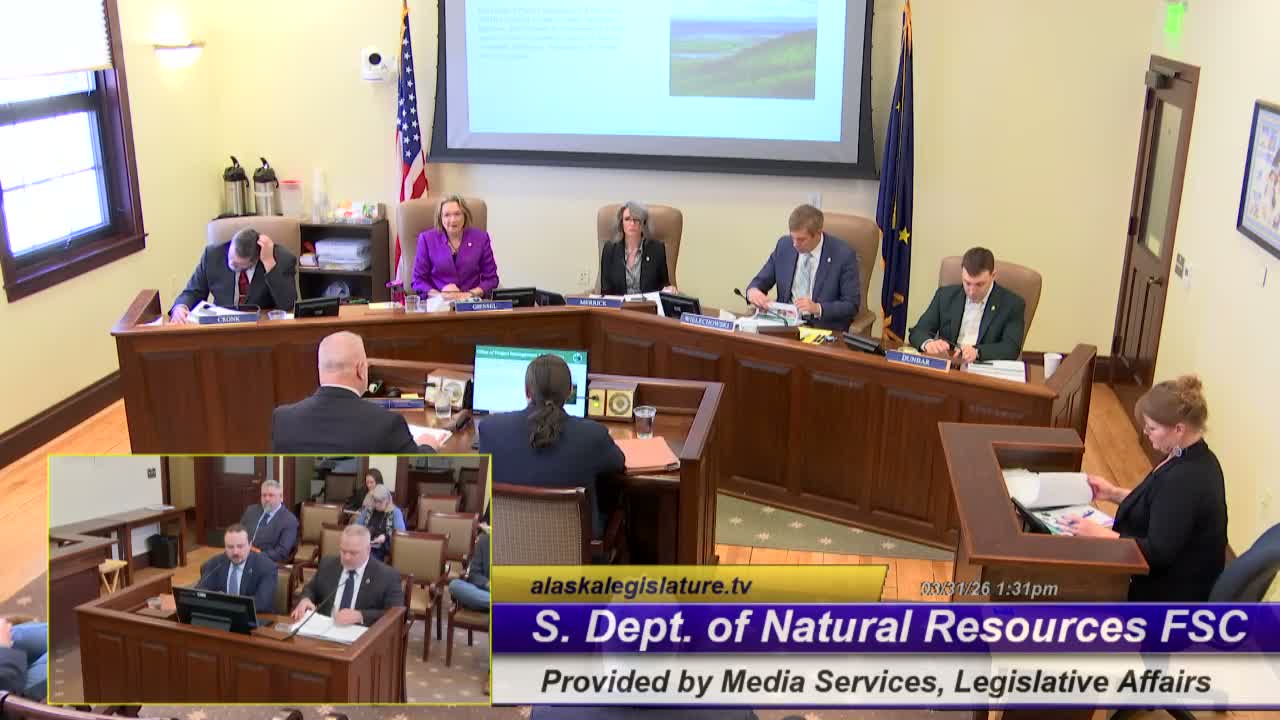
At a March 31 Senate Finance Subcommittee hearing, DNR commissioner designee John Crother described the Office of Project Management and Permitting as the state’s coordination hub for major projects and said the office has 15 positions with about three vacancies; the department has not yet monetized carbon offsets and is reassessing project approaches.
Chair Senator Merrick opened the Department of Natural Resources presentation and asked John Crother to finish the department’s FY2027 overview. For the record, Crother identified himself as commissioner designee of the Department of Natural Resources and described the Office of Project Management and Permitting (OPMP) as the unit that coordinates permitting for large mines, oil and gas developments and infrastructure across state, local and federal lines.
Crother said OPMP is often funded through reimbursable services agreements and that the office sometimes keeps positions vacant until a new project requires additional capacity. "At this time, I believe we may have 3 PCNs vacant," he told the committee. Ashley Adecco, who put herself on the record as Executive Director of the Office of Project Management and Permitting, confirmed the office has 15 positions in total.
Senator Giesel asked whether the Critical Minerals Accelerator Project led by the University of Alaska Fairbanks would require OPMP permitting. Crother said that if the project expanded into new processing or disturbed previously unmined tailings cells, additional permits might be required and OPMP could either fold that work into an existing coordination agreement or support new permitting as needed.
Crother also described OPMP’s federal coordination role when federal actions affect Alaska and highlighted the Arctic Strategic Transportation Resources (AStar) effort to inventory North Slope gravel and hydrology for long‑term community infrastructure planning. On carbon programs, Crother said the state has not yet initiated any revenue‑generating projects. "We have at this time not initiated any specific projects that generate revenue," he said, adding that registry standard changes forced a reassessment of some contracted inventory‑for‑management (IFM) projects and that the department is exploring other project types such as forest management, biochar and downed‑tree projects.
Crother told the committee the department has been using federal grant funds to build a public dashboard tracking sequestration work and said no additional budget requests are pending at this time. He recommended continuing market engagement and study rather than asking the legislature for new authorities immediately.
The exchange left the committee with specific, recordable points: OPMP is resourced to handle complex permitting but currently lists about three vacancies against 15 positions; the Critical Minerals Accelerator could require new permits depending on its design; and despite previous revenue projections, the department has not yet realized carbon‑offset revenue and is recalibrating its approach.
The committee moved on to parks and fire issues after the presentation; Crother and Adecco agreed to provide corrected vacancy counts or clarifying details for the record if needed.